
AgriS Chases an Ingredients Multiple With Brands, Capital and R&D
— Vietnam Vanguard
September 18, 2026
At roughly $840 million, AgriS trades like what it has historically been: a sugar and commodity agribusiness. The market usually prices that category around 10x EV/EBITDA. Ingredients and flavors companies, the category AgriS is trying to enter, price closer to 14x, and the best of them clear 18x. That gap, worth potentially over a billion dollars in valuation alone, is what AgriS is now moving to close on three fronts simultaneously: turning raw output into brands, using ESG-linked capital to fund the transition, and tying commercialization to a new international R&D base.
The multiple gap is real, and getting sharper
PKF Investment Banking's June 2026 data puts median Agribusiness EV/EBITDA at 10.2x against 13.9x for Ingredients/Flavors. Lincoln International's March 2026 report shows the same pattern inside a single peer set: Balchem, built on proprietary microencapsulation technology, trades at 18.8x; Ingredion and Tate & Lyle, still leaning on commodity starches and sweeteners, sat at 6.1x–6.3x.
That commodity discount didn't stay theoretical for long. In June, Ingredion agreed to acquire Tate & Lyle outright for roughly $3.6 billion — a 59%+ premium — specifically to accelerate its own shift into specialty ingredients. The market's message to the sector was blunt: standing still as a commodity producer gets you bought at a discount; moving toward differentiation gets you a premium, whether that premium shows up in your trading multiple or in someone else's takeover price. AgriS is trying to earn that premium organically rather than wait to be acquired for it.
Front one: raw material to brand
Betrimex, an AgriS affiliate, owns Cocoxim — Vietnam's best-selling coconut and plant-based water brand by volume in 2025, per Euromonitor. That's the clearest evidence AgriS has that it can convert agricultural input into a branded consumer product with pricing power, rather than sell commodity output at prices it doesn't set. It's a small piece of the business today. It's also the template AgriS is pointing to for everything else in its portfolio.
Front two: ESG capital as cheaper, more patient capital
AgriS has raised over $400 million from IFC, DEG, responsAbility, FMO/FCB and ING over the past two years, all tied to sustainability and governance commitments rather than pure growth capital. The most concrete recent piece: a $50 million IFC loan, approved in 2025, funding a new refinery and logistics hub in Tay Ninh, tied to AgriS's Net Zero 2035 target — replacing an older Dong Nai facility with a modern one. Development-finance money of this kind tends to be cheaper and stickier than commercial debt, and its presence signals a governance bar international investors have already underwritten. That's a credibility asset a purely domestic agribusiness doesn't have.
Front three: R&D as the commercialization engine
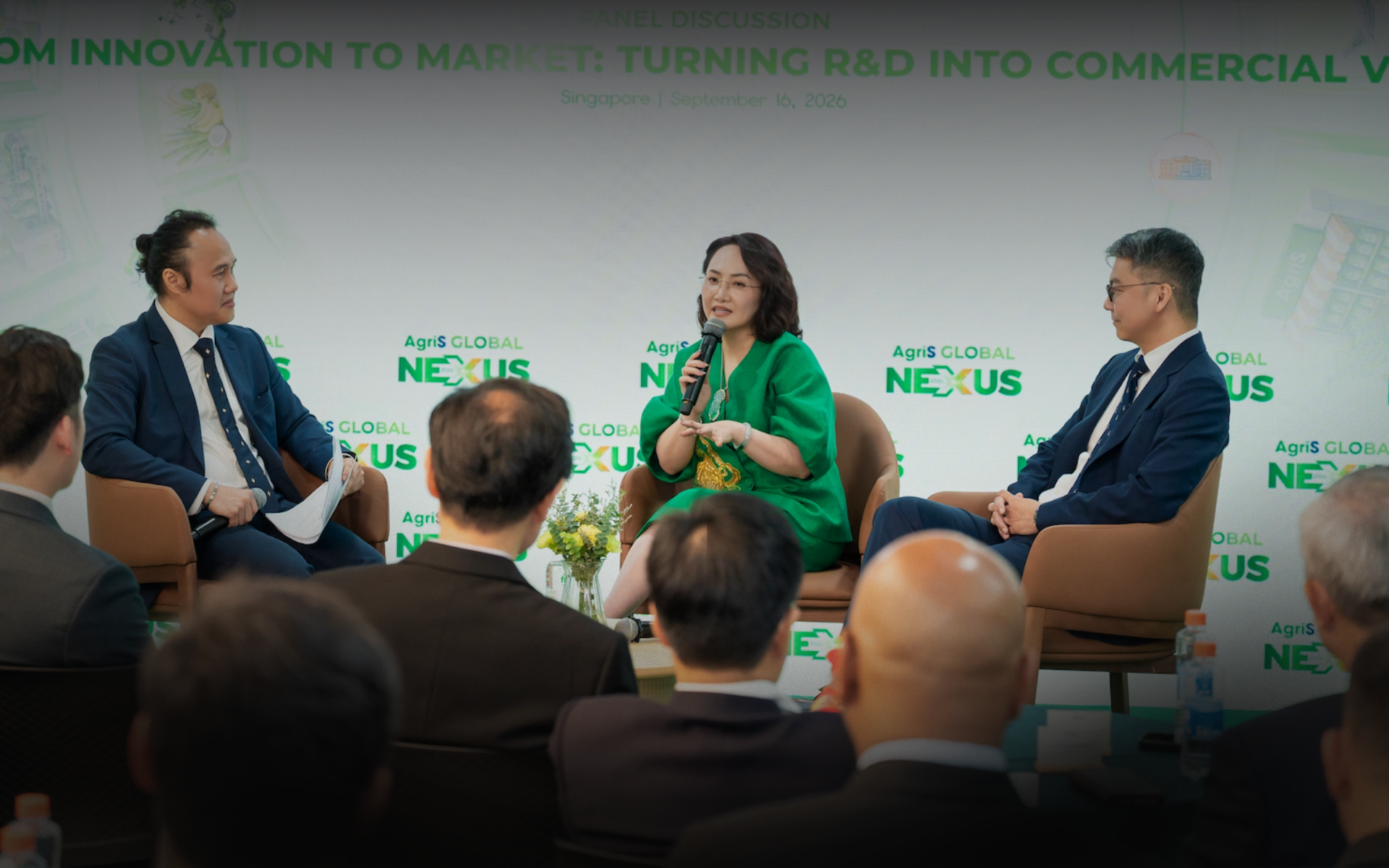
On September 16, 2026, AgriS opened the AgriS Global Innovation Center in Singapore, alongside Nanyang Technological University, at an event — AgriS Global NEXUS 2026 — attended by Vietnam's Ambassador to Singapore, Trần Phước Anh, along with representatives from Enterprise Singapore and EDB. AgriS and NTU also signed on to develop a joint lab on adaptive biological innovation, expected to sit at FRESH@NTU, linking Singapore-based research capability to AgriS's field-testing, production and commercialization base back in Vietnam. The center is meant to connect AgriS's 11 AgTech Hubs and close to 9,000 hectares of research farms across Vietnam, Laos, Cambodia, Australia and Indonesia to the international science network anchored in Singapore. AgriS also signed a memorandum with the Vietnam Academy of Science and Technology.
The logic: research alone doesn't move a multiple. Research that gets licensed, product-tested and sold does. Locating the R&D interface in Singapore — where the capital, the trade networks and NTU's agri-food research base already sit — is a bet that commercialization moves faster when the science and the money are in the same room.
What it adds up to
AgriS has said publicly it's targeting a $2.7 billion market cap by 2030, more than triple where it trades today. Getting there means these three fronts stop being separate initiatives and start showing up together in the numbers: branded revenue as a rising share of the mix, financing costs that reflect the ESG premium already built into the balance sheet, and R&D that converts into products investors can underwrite rather than research they have to take on faith.
For investors, the signal to watch isn't the market cap target itself — it's whether branded and processed revenue actually grows as a share of the business, since that's the only thing that moves AgriS from a 10x agribusiness multiple toward a teens-multiple ingredients company. For Vietnam's broader corporate landscape, AgriS is one of the few domestic companies attempting this migration in public, with international capital and an international research partner attached to the attempt. If it works, it becomes a rare thing: a Vietnamese agribusiness that competes on the same multiple, not just the same revenue line, as the global ingredients players it's now being benchmarked against.
Vietnam Vanguard
September 18, 2026