

Ten Hard Truths About Vietnam's Capital Markets
What the Capital Intelligence Forum (CIF) 2026 revealed — and what the evidence confirms.
Members' Briefing · Reporting from CIF 2026, Ho Chi Minh City · 12 min read
Vietnam has built one of Asia's most compelling growth stories, attracted substantial foreign direct investment, and set its sights on high-income status by 2045. The country's economic ambition is not in question. But ambition and investability are not the same thing.
At the Capital Intelligence Forum 2026, leaders from KPMG, SSI Securities, Dragon Capital, HSBC, Hanwha Life, PVI Asset Management, VinaCapital, S&I Ratings, BNY, DBS, the U.S. Embassy and Vietnamese businesses spent a full day examining what stands between economic potential and capital-market maturity. Their views were not identical. But they repeatedly returned to the same constraints: excessive reliance on banks, insufficient long-term institutional capital, weak market depth, inconsistent pricing signals, limited investor trust, and too few companies genuinely prepared for public or international capital.
These are not reasons to be bearish on Vietnam. They are the hard truths that must be confronted if Vietnam's capital markets are to finance the country it intends to become — and, for members, the specific mechanics, dates and figures the room actually discussed, not the version that made it into headlines.
01. Vietnam's financing architecture needs to catch up with the country’s economic ambitions
Vietnam's infrastructure requirements alone are estimated by the World Bank at approximately US$30 billion annually, with a cumulative financing shortfall of US$94 billion between 2019 and 2040.
Yet between 2019 and 2023, the Vietnamese economy mobilized an annual average of approximately US$53.5 billion through bank financing, compared with only US$2.9 billion through the stock market.
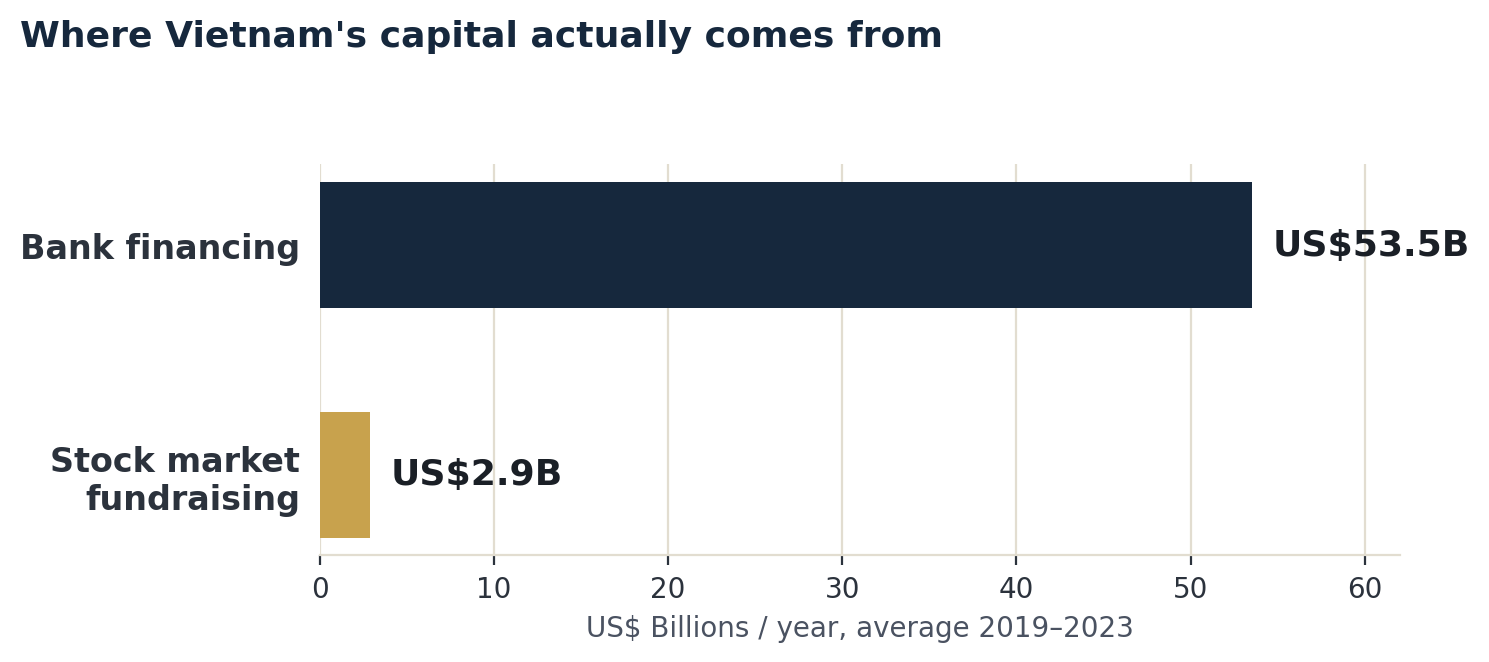
This was the central tension in Warrick Cleine's CIF keynote. The KPMG chairman — 27 years in Vietnam — pointed to a specific number that framed the entire forum: Vietnam needs roughly $1.5 trillion in infrastructure financing over the coming decades (per an IFC estimate he cited), against a $500 billion economy. "Given we're a $500 billion economy," he said, "these numbers are huge."
The hard truth is that economic growth does not automatically produce an efficient capital market. Without deeper equity, bond, pension, insurance and investment-fund channels, the financing system will struggle to support the scale and duration of investment Vietnam is targeting.
02. Banks are carrying a burden they cannot carry indefinitely
Vietnam's financial system remains unusually dependent on bank credit. The IMF reported total credit reached approximately 136% of GDP in 2024 — exceeding most emerging markets — with credit growth accelerating to 19% year-on-year by June 2025.
Cleine put a finer point on it from the audit chair: "It's two or three times what people feel comfortable about in an emerging economy. It's about the same ratio as the United States... but the United States is a much richer and deeper economy." Vietnamese credit is also collateral-driven — secured overwhelmingly by property — which Cleine argued actively misdirects capital: "You're pushed into property when Vietnam wants you to move into tech or innovation."
"There is no such thing as a free lunch. If we in business, as bankers, or as investors ignore the current state of play... there will be a significant opportunity cost for us as businesses."
— WARRICK CLEINE, CHAIRMAN, KPMG VIETNAM
Bank lending is indispensable, but banks are funded by shorter-term deposits and prefer tangible collateral. That creates a structural mismatch: infrastructure, technology, and asset-light businesses need patient capital whose returns emerge over years, not quarters. A deeper capital market is not an optional alternative to bank credit — it is necessary financial infrastructure.
03. Market capitalization is not the same as capital formation
Vietnam's combined capital markets had reached more than 90% of GDP by 2023. That looks substantial next to the region — until you separate size from function.
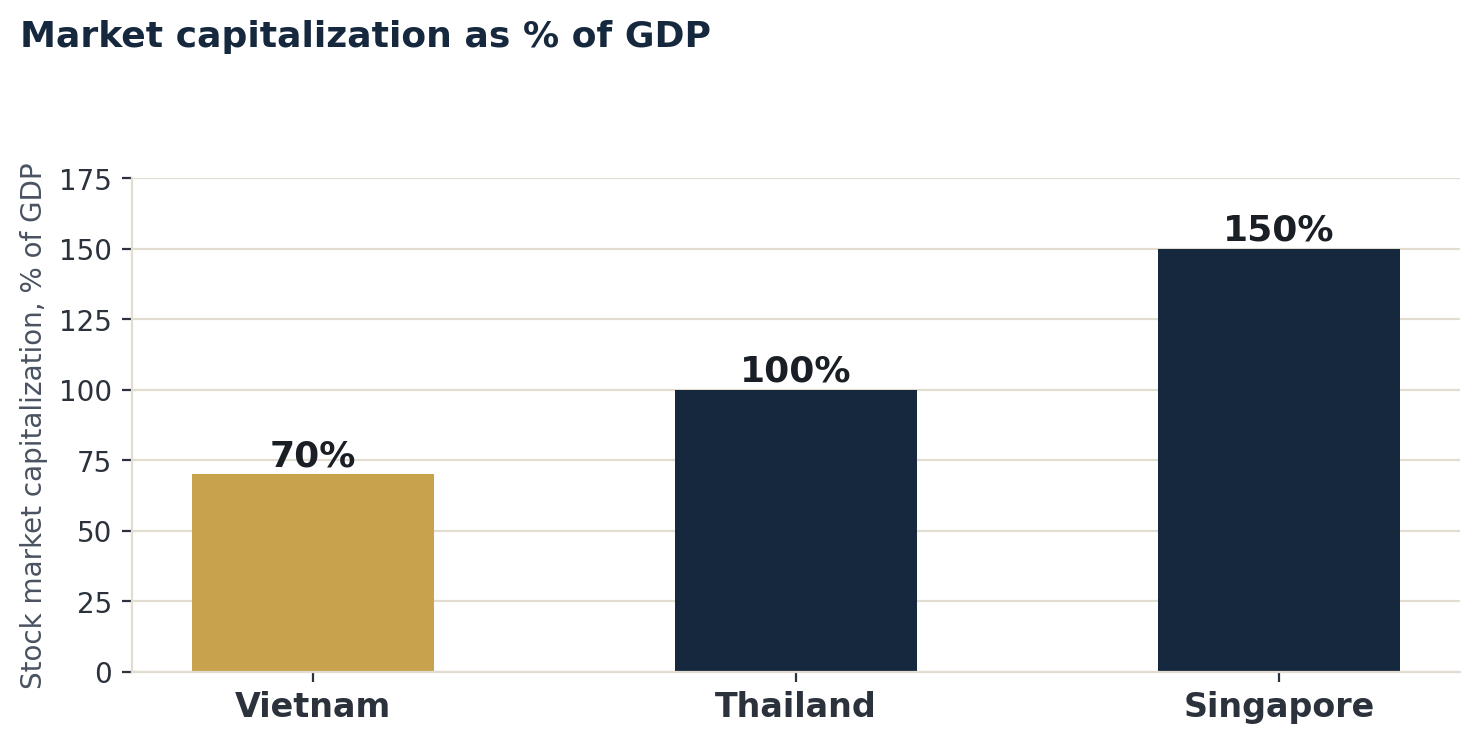
The World Bank found that despite Vietnam's relatively high market cap, the amount actually raised through the exchanges remained modest: equity fundraising averaged roughly VND37 trillion (~US$1.5 billion) annually between 2019 and 2023. A rising index increases the value of shares already in circulation — it does not mean companies are successfully raising new capital to invest, expand or innovate. The real test of an equity market is not what listed companies are worth. It's how effectively the market channels new money into productive enterprises.
04. The FTSE upgrade is a milestone — not a declaration that the market is finished
FTSE Russell has confirmed Vietnam moves from Frontier to Secondary Emerging Market status effective the opening of trading on September 21, 2026 — recognizing reforms including a non-prefunding mechanism for foreign institutional investors and a formal failed-trade process. The World Bank estimates the reclassification could generate US$3–5 billion in first-year portfolio flows.
● CIF EXCLUSIVE — NOT IN THE PRESS RELEASE
SSI's Thomas Nguyen gave members the mechanics headlines don't carry: on the effective date, index-tracking funds — he named Vanguard specifically, as it is public and mandated to replicate the FTSE index — become contractually obligated to buy specific Vietnamese stocks in four tranches over 12 months. His estimate: roughly $2 billion, price-insensitive, from that single manager alone.
"They're going to buy lots of VIC. It doesn't matter what you think about VIC — they're gonna buy VIC... this is legal front-running, and there's probably only two times in your lifetime when you get it: when FTSE does this, and when MSCI does."
His view: don't fixate on the $2–5 billion headline number — it's a byproduct. What matters is what the reform effort behind it unlocks next.
But an index upgrade does not automatically deliver a diversified investor base or efficient capital allocation. Vietnam remained in the MSCI Frontier Markets Index as of the most recent 2026 review, and MSCI inclusion is not expected before 2030. Why the delay matters more than most coverage admits:
● CIF EXCLUSIVE — WHY MSCI IS THE HARDER DOOR
VinaCapital's Michael Kokalari explained, on the record, why a window that was "wide open for years" narrowed: Indonesian issuers colluded to inflate individual stock prices until they cleared MSCI's free-float threshold, sold the inflated shares to foreign funds, and were added to the MSCI EM Index. BlackRock complained. MSCI now screens free-float far more aggressively — collateral damage that lands on every other frontier market seeking promotion, Vietnam included.
"All the other things that need to be solved are now what I would call necessary but not sufficient... this will be a difficulty for us." — Michael Kokalari, VinaCapital
● CIF EXCLUSIVE — THE SINGLE MOST IMPORTANT DATE TO WATCH
Thomas Nguyen flagged the Central Counterparty (CCP) clearing system — not the FTSE date — as the real near-term catalyst: the State Securities Commission plans to test it in autumn 2026 and roll it out in early 2027. "If we do that properly," he said, "we'll likely be put on the MSCI watch list next June." That is the milestone members should track, not September 21 itself.
Passive inflows are mechanical — index funds buy because the rules require it, which improves liquidity but does not guarantee active global investors develop long-term conviction in the broader market. The upgrade opens a door. Vietnam must still give investors reasons to stay after they walk through it.
05. Foreign capital cannot substitute for a domestic institutional investor base
The World Bank estimates assets held by Vietnamese institutional investors — insurance, pension and investment funds combined — at only about 19% of GDP in 2023, below most regional peers. Domestic individual investors account for roughly 95% of securities accounts.
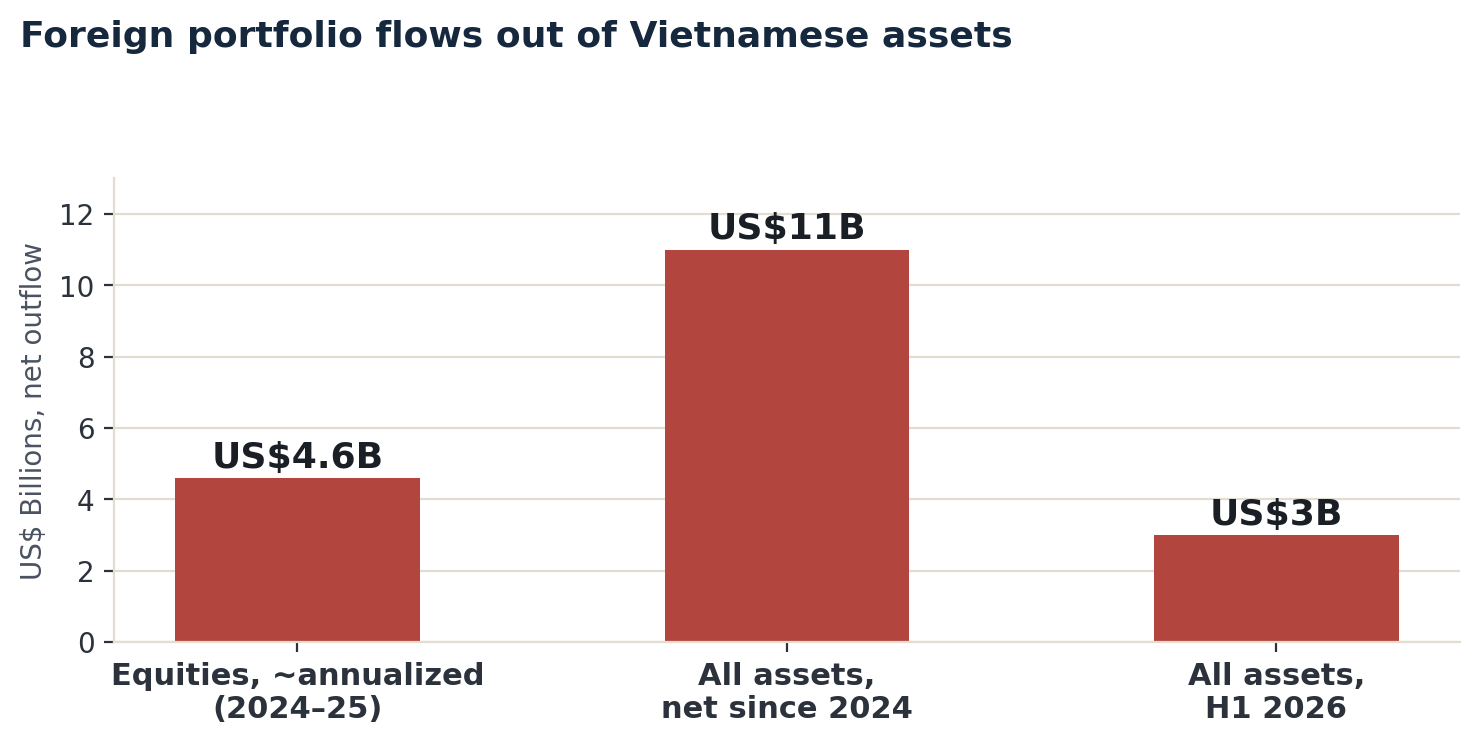
SSI's Thomas Nguyen framed the paradox members should sit with: "the more you want foreign money, the more you should be strengthening your base at home." Foreign investors can enter and leave as global risk conditions change; pension funds, insurers and professional domestic managers provide the patient capital and liquidity that let foreign investors exit when necessary — which, counterintuitively, is what makes them comfortable entering in the first place.
● A DATA POINT MOST COVERAGE MISSES
DBS's James Lo noted Vietnam attracted $5 billion in private capital across 149 deals last year — including $500 million in early-stage VC — even as roughly $5 billion left the listed market. The story isn't "capital is fleeing Vietnam." It's that private and public capital are behaving completely differently, and the industry hasn't found a way to convert private-market conviction into public-market allocation.
06. The corporate bond market is recovering — but it is not yet a deep, long-term market
Vietnam needs corporate bonds to finance infrastructure and businesses that can't depend exclusively on bank loans. Recovery from the 2022–2023 turmoil should not be confused with structural maturity.
Late-payment rate, 2022 crisis peak
~12%
Late-payment rate, cited at CIF 2026
~1%
That is a genuine, quantified improvement, and it came from mandatory credit ratings weeding out over-leveraged issuers and better disclosure by the Hanoi Exchange. VBMA data cited at CIF also shows secondary trading volume up roughly 20% year-on-year, and bank-issued bonds — once nearly impossible to bring to market — now trade 400–500 basis points inside corporate bonds, evidence of genuine risk differentiation for the first time.
Set against that: more recent ADB data show corporate bond issuance contracted 81.4% quarter-on-quarter in Q1 2026 as financial conditions tightened — a reminder of how sensitive issuance remains to market cycles. Both things are true at once: the plumbing is better; the market is still thin, short-duration (over 90% of bonds are private placements under five years), and dependent on banks as issuer, buyer and market-maker all at once — a role banks in Malaysia, Korea and Japan also played early, but grew out of.
● CIF EXCLUSIVE — A CONCRETE FIX, NOT A WISH LIST
PVI Asset Management's Ngô Thế Triệu laid out a specific mechanism Vietnam hasn't used yet: partial credit guarantees from CGIF (ADB) or IFC to lift below-investment-grade issuers into investable territory — the same tool Malaysia used to build its bond market. Paired with tranching (a government-backed "first loss" layer), this could unlock issuance without waiting years for a sovereign upgrade.
On the buy side, he pointed to a specific, already-existing pool: Vietnam's social insurance and life insurance assets total roughly $90–100 billion — large enough to be a credible anchor buyer base for long-duration bonds, if regulation stopped forcing life insurers into government bonds and deposits by rule rather than by credit assessment.
07. Vietnam still pays a trust premium
Trịnh Quỳnh Giao of PVI Asset Management described the cost of capital in five words that framed the entire first panel.
"The cost of capital of a country is not just a number. It's the price of trust — in policy, in the law, in enforcement, and in economic stability."
— TRỊNH QUỲNH GIAO, CEO, PVI ASSET MANAGEMENT
That's consistent with Vietnam's sovereign position: S&P rates Vietnam BB+ with a stable outlook — one notch below the BBB- investment-grade threshold. VinaCapital's Michael Kokalari made the more uncomfortable point live on stage: on hard quantitative criteria — government debt-to-GDP, fiscal balance — "Vietnam is pretty much already an investment-grade country. We pretty much tick all the boxes." Even the headline weakness, FX reserves at roughly two months of import cover against a three-month minimum, looks different once you strip out imports used to produce high-tech exports: Kokalari puts adjusted cover closer to six months. What's actually holding the rating back, in his words: "policy needs to be normal like other countries." He pointed to Vietnam running three different policy interest rates simultaneously — a decade after the IMF recommended a single, stable interbank target — as exactly the kind of self-inflicted unpredictability that costs more than the fundamentals justify.
● CIF EXCLUSIVE — THE PRECEDENT NO ONE ELSE IS CITING
Former U.S. Ambassador Marc Knapper skipped the usual Southeast Asian comparisons and reached for Poland in the 1990s — an economy still carrying the "hangover" of central planning, unattractive to investors, with no natural advantages over Vietnam today. Poland's actual edge, he argued, was discipline: transparent, boringly predictable rules on property valuation and law-making that didn't change with elections. "By the time Poland joined the EU in 2004, it wasn't a question of should I invest there — it was a question of how much."
A sovereign rating doesn't fully capture an economy or its companies. But it shapes financing conditions, and strong Vietnamese companies operating inside a below-investment-grade sovereign may face a higher cost of capital than comparable businesses elsewhere. PVI's own numbers made this concrete: Masan, a genuinely strong credit, still pays roughly 2 percentage points more to raise debt than comparable Indonesian issuers. Vietnam competes for capital against every other market available to global investors — not just against its own past.
08. The financial system still rewards collateral more readily than enterprise quality
One of CIF's most instructive examples came from DatVietVAC, the media and entertainment company preparing its IPO.
Annual free cash flow
$18–20M
Total bank borrowing on the balance sheet
~$10M
Source: Hung Phan, Head of Strategy Development, DatVietVAC (VVAC)
A 30-year-old, continuously profitable company generating meaningful free cash flow still can't raise proportionate bank debt — because an asset-light media business doesn't hold real estate. "Bank lending is tough for us," Hung Phan told CIF. "For us, IPO or equity capital markets is a way to tap into the funding we need for future growth."
That's not one company's financing problem. It's a structural weakness the World Bank has documented directly: equity financing is especially important for startups and innovative companies that lack conventional collateral or long profit histories — exactly the technology, creative and consumer-platform businesses Vietnam says it wants more of. If capital keeps following property more easily than productivity, Vietnam risks financing yesterday's economic model more than tomorrow's.
09. Vietnamese wealth is real, but much of it is not institutionally mobilized
Dragon Capital's Will Ross made the sharpest reframe of the wealth-management panel.
"Wealth management exists in Vietnam at scale. It's just not institutionalized. Putting your money in gold as an alternative is a wealth management decision with a return target and a risk implication — it just happens at the household level."
— WILL ROSS, DRAGON CAPITAL
Vietnamese families already make active allocation decisions — property, gold, dollars, deposits, increasingly stablecoins for yield. What's missing is the migration of that decision-making into professionally managed, diversified, long-term portfolios. Panelists converged on the same list of frictions:
First-generation entrepreneurs remain capital-concentrated in their own businesses
Families prefer assets that feel tangible and controllable
Long-term investment products are hard to understand as sold today
Trust in advisers and institutions remains uneven
Tax incentives for pensions and long-term savings remain minimal
Products are judged against deposit and property returns, not inflation-adjusted long-term return
HSBC's Ranganath Ananth put a number on the awareness gap: mutual-fund participation as a share of GDP runs 20–30% in developed Asian markets. In Vietnam, it's under 2%. His diagnosis wasn't lack of product — it was the absence of financial-planning conversations that start with a client's goals rather than a product to sell. Hanwha Life's Hoài Giang Hoàng added a policy-level constraint few discuss: Vietnam's tax incentives for pension contributions remain far below regional norms, which mutes demand for the long-duration products insurers most need to sell to build a real domestic bond-buying base.
The hard truth: Vietnam doesn't simply need more investment products. It needs institutions that earn the right to manage family wealth — and, per Ross, a policy nudge (tax-efficient, lock-up savings vehicles) and a competitive return story tied visibly to where the roughly $1.4 trillion in five-year investment Vietnam needs is actually being spent.
10. Global capital rewards investability — not national ambition
Vietnam's growth narrative attracts attention. But global investors allocate to securities and companies, not to national stories in the abstract.
BNY's Teresa Woo explained how American Depositary Receipts (ADRs) work as a bridge for Vietnamese issuers into deeper U.S. capital pools — but the bridge is only open to companies that clear a demanding, specific bar:
Credible corporate governance and independent oversight
IFRS-compatible financial reporting
Audited financial statements (Big Four, sustained multi-year)
Appropriate free float
Clear, disclosed use of proceeds
Dedicated investor relations capability
Consistent, ongoing disclosure
A defensible, articulated growth strategy
Protection of minority shareholders
Credit rating from a recognized agency
DatVietVAC and GELEX Infrastructure both described, in specific terms, the work required before approaching institutional capital: independent board directors, sustained Big Four audits, an SAP ERP backbone, a Moody's credit rating, and — in GELEX's case — an 18-month rebuild of group-level risk management with BCG and Roland Berger, now reporting risk indicators to the board every quarter.
"We are merely a bridge to capital... Listings here should have been oversubscribed many times — they're very hot — but there's just not enough capital to sustain long-term interest."
— TERESA WOO, BNY
This may be the hardest truth of all: the shortage is not always capital. Frequently, it's the shortage of companies sufficiently prepared to receive capital on institutional terms.
What these truths add up to
Vietnam's capital markets are not failing. They are unfinished.
The country has made real progress: the FTSE upgrade proves difficult technical reforms can be delivered on schedule; corporate bond regulation and disclosure have measurably improved; non-prefunding and English-language IFC standards are lowering the barrier for international investors. But the next stage — the one that actually finances $1.4 trillion in growth — is harder than an index classification.
From bank dependence → diversified financing
From individual speculation → institutional investment
From market capitalization → genuine capital formation
From short-duration instruments → patient capital
From collateral-based lending → enterprise-based financing
From selling products → earning investor trust
IF YOU ALLOCATE CAPITAL
The FTSE flow is mechanical and largely priced by those paying attention. The CCP rollout (test: autumn 2026, live: early 2027) is the catalyst that isn't priced yet — and the one that gates a future MSCI watchlist add.
IF YOU'RE RAISING CAPITAL
The BNY/ADR checklist and the DatVietVAC/GELEX preparation timelines are the actual bar, not a formality. Foreign investors "get" asset-light, high-return models faster than domestic ones do.
IF YOU SELL FINANCIAL PRODUCTS
The gap isn't product count, it's the planning conversation. Sub-2% mutual fund penetration won't move on new SKUs alone — it moves on trust and tax incentives.
The optimistic conclusion is that none of these constraints is permanent. The hard conclusion is that economic growth alone will not remove them.
Sourcing & Methodology
This briefing draws on the full CIF 2026 transcript, including Warrick Cleine's keynote and all four panel discussions (investor confidence & sovereign rating; public and private capital; wealth management; issuer access to global markets). Direct quotations are taken verbatim from the recorded transcript. External statistics were checked against primary sources as of July 29, 2026:
World Bank — "A Turning Point for Việt Nam's Capital Markets" (2026) & "Taking Stock: Reaching New Heights in Capital Markets"
IMF — 2025 Article IV Consultation, Vietnam
FTSE Russell — March 2026 Semi-Annual Country Classification Review; confirmed effective date September 21, 2026
MSCI — May 2026 Index Review (Frontier Markets classification confirmed)
S&P Global Ratings — 2026 Asia-Pacific Sovereign Rating Trends (Vietnam: BB+, stable)
Asian Development Bank — AsianBondsOnline, Q1 2026 Vietnam market summary
Conference statements represent individual speakers' perspectives at the time of the forum and should not be interpreted as investment advice, an offer, or a solicitation to buy or sell any security. Figures presented from the stage are approximate as delivered and attributed to the speaker, not independently audited by Vietnam Vanguard. This briefing is provided exclusively to Vietnam Vanguard members and is not for external distribution.