
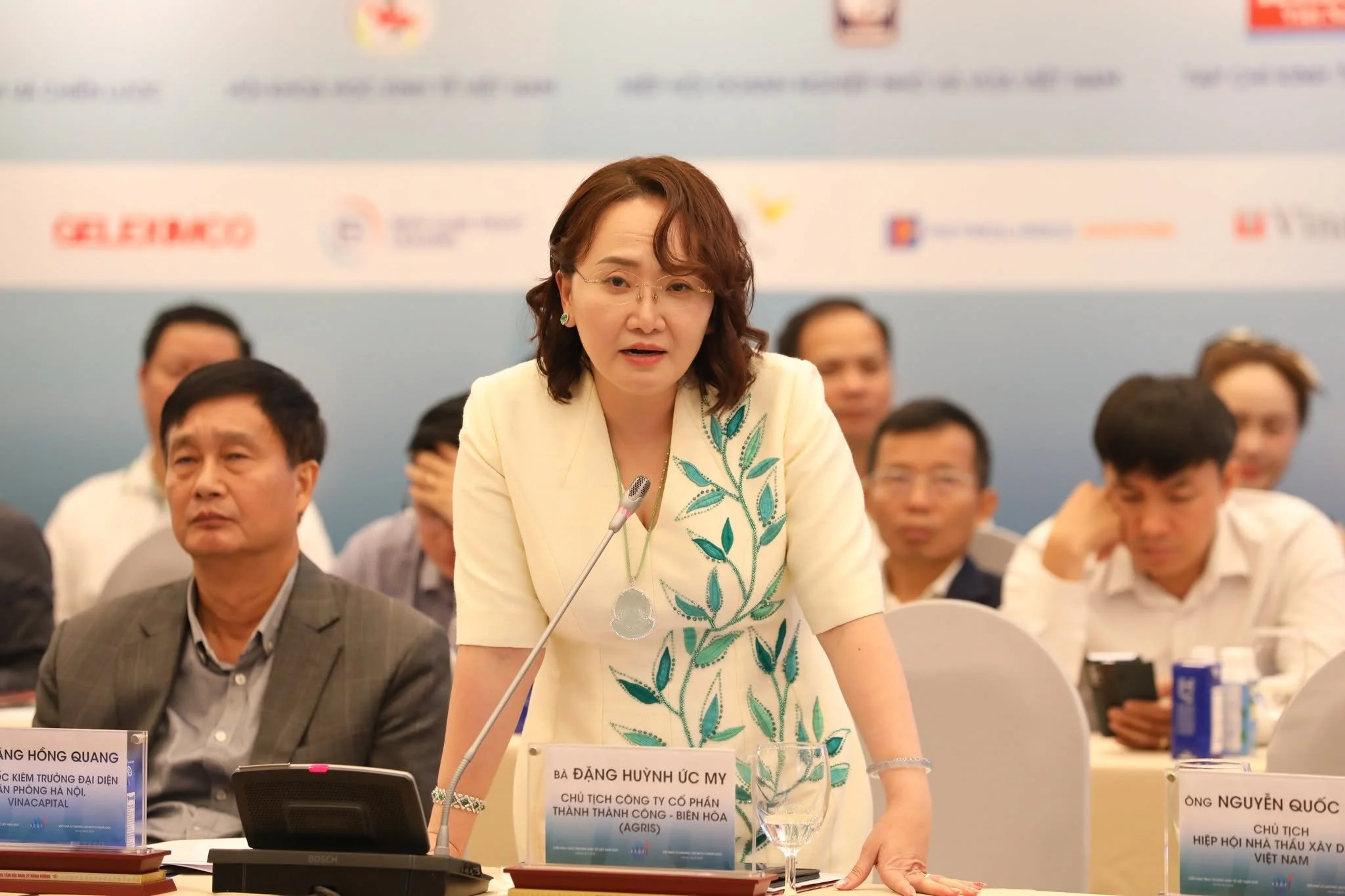
AgriS’s Chairlady Dang Huynh Uc My speaking at on “Digitizing agricultural data for growth” at the Vietnam Economic Growth Forum 2025 (VEGF), hosted by the Central Committee for Policy and Strategy.
At around $840m, AgriS is already valued near the upper limit of what markets pay a conventional agricultural producer. Reaching the next level will depend on Chairlady Dang Huynh Uc My's ability to create value from intangible assets: technology, brands and command of the supply chain.
Twenty years ago, when Dang Huynh Uc My joined the management of Thanh Thanh Cong, the family group built by her father, the businessman Dang Van Thanh, one of her first moves was to set up an investment department. It laid the groundwork for a sweeping overhaul of the family's operations and finances, and it met fierce resistance from the old guard.
That decisive step opened the way for a restructuring that gradually turned a traditional sugar producer into AgriS, a group run on modern lines. After more than a decade as vice-chair, she became chair of the board in July 2024, formally taking the helm.
A change at the top usually brings new strategic commitments. That is all the more true when the new chair is one of the few next-generation leaders of a Vietnamese business family to command wide respect in the business community. Her style combines financial sharpness, diplomatic skill and a relentless work rate.
“There's no such thing as an easy pace when you work with me,” she said at a panel discussion marking the opening of the AgriS Global Innovation Center in Singapore in mid-September. “I think like a financier, but I come from a farming family. I'm used to enormous pressure.”
Her standing extends beyond Vietnam. Fortune has named her to its Most Powerful Women Asia list two years running, in 2025 and 2026.
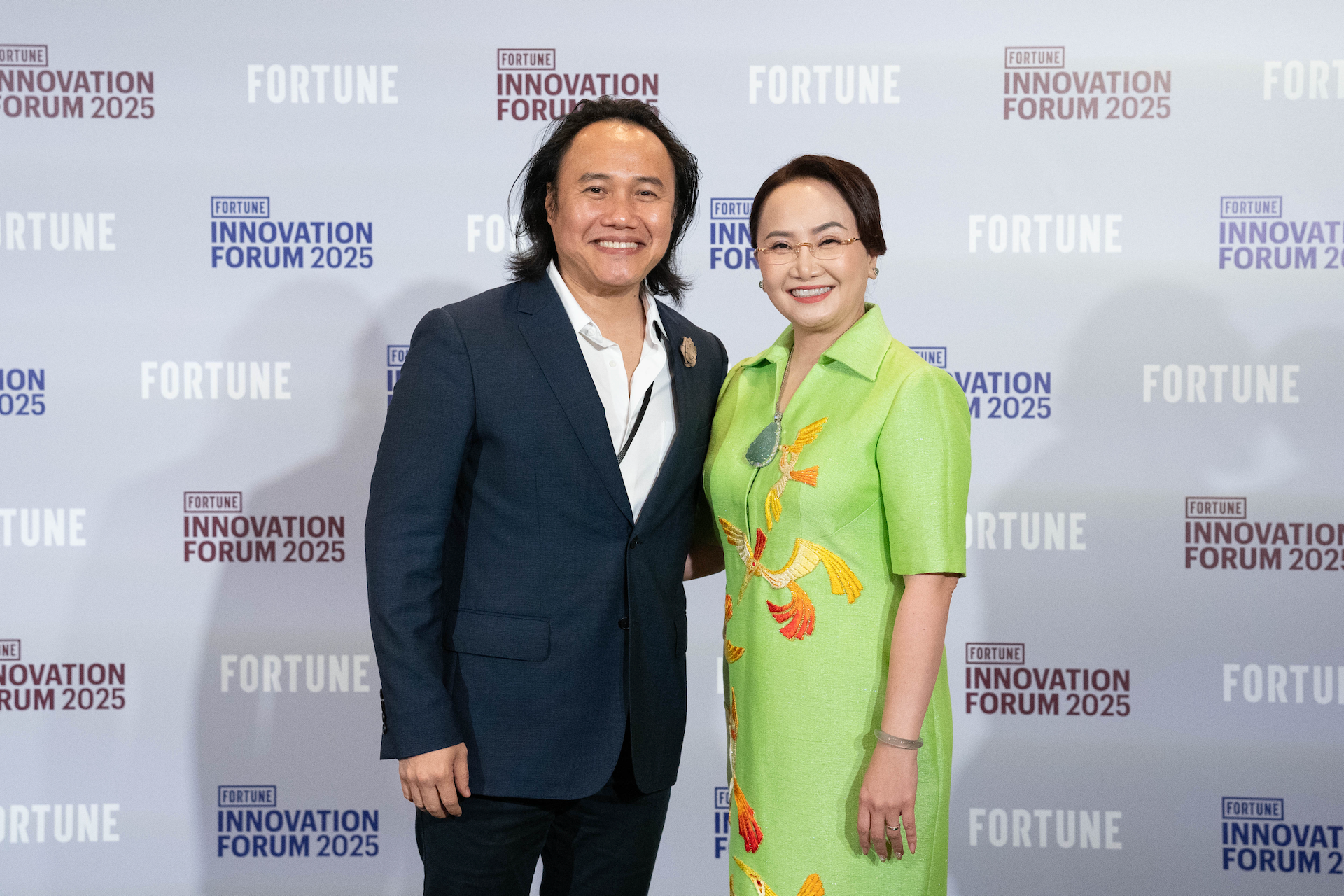
Chairlady Dang Huynh Uc My (Omi Dang, right) at Fortune Most Powerful Women Asia Awards Ceremony in Kuala Lumpur, Malaysia (2025).
Against that backdrop, AgriS's public targets for 2030 stand out. It is aiming for revenue of $2.3bn and a market capitalization of $2.7bn, roughly double today's revenue and triple its current value. For a sector known for volatility and modest growth, that is a strikingly bold commitment.
The question then becomes a technical one. Can moving up the value chain lift, many times over, the multiple the market pays for each dollar of EBITDA? And if so, which route should AgriS take?
A higher rung on the valuation ladder
Global markets have already answered that question with data. The further a company moves away from raw commodities and towards proprietary technology, the higher the multiple it commands.
Lincoln International's quarterly review of the food and beverage sector shows the gap most clearly. Balchem, a US group built on proprietary technology and specialised formulations, trades at 21.2 times EV/EBITDA. Ingredion, which still depends heavily on agricultural raw materials, trades at 5.8 times. That is a gap of more than three and a half times within the same ingredients sector.
Across the industry, PKF International puts specialty ingredients and flavours at the top of the valuation table, at an average of 13.9 times. Traditional agriculture trails at 10.2 times and consumer food at 9.1 times.
Second-quarter 2026 deal data from DealAscent, an M&A advisory firm, tell the same story. Sellers of raw ingredients achieved a modest 6.1 times EBITDA. Companies holding proprietary technology and valuable intellectual property commanded 20 to 21 times, a gap of roughly 3.3 times. The same premium has shown up in landmark acquisitions such as IFF's takeover of Frutarom and Novonesis's purchase of dsm-firmenich's share of their feed-enzymes business.
Together, these trends trace a path by which an agricultural company can raise its enterprise value, as several global groups have done. Südzucker, Germany's and Europe's largest sugar producer, has moved beyond raw sugar, whose fortunes track market prices, into functional ingredients through BENEO, which sells on stable, long-term supply contracts. ADM, the American agribusiness giant, has likewise built up its higher-value Nutrition business as a separate segment, distinct from its thin-margin grain trading, to give the market a new reason to value it.
For both companies, the basis of valuation has changed. They are judged less on swings in commodity prices and more on the stability and repeatability of cash flows from deep processing. A full re-rating takes time, of course, and arrives only as the higher-value businesses grow into a larger share of revenue.
Three strategic shifts
The German and American cases point to the same reality. From any given crop, the greatest value goes to the company that owns the processing technology and the brand, not to the one chasing volume.
That is also the logic behind AgriS's growth plans, which Ms. Uc My set out at the company's annual shareholder meeting. Growth in agriculture, she argued, can no longer depend on output or on exploiting natural resources. It has to come from productivity, technology and added value. In practice, that view rests on three strategic shifts.
First, from raw commodity to consumer brand. Betrimex, in which AgriS holds a stake, has 73% of Vietnam's domestic coconut-water market and exports to more than 70 countries. The business places AgriS among branded food companies, whose pricing power reaches all the way to the end consumer. Owning a segment-leading brand is a fundamentally different kind of asset from a plantation that supplies raw sugar in bulk to food and beverage manufacturers.
Second, from internal funding to international institutional capital. Over the past two years AgriS has attracted more than $400m from major institutions such as IFC, DEG and ING. The value of that capital goes beyond financing costs and cash flow. Securing it shows that AgriS's governance, financial reporting and supply-chain transparency have passed some of the most rigorous due-diligence standards in the market, strengthening its credibility with investors.
It also sends an important signal to investors who remain cautious about agriculture. International financial institutions are not turning their backs on the sector. What they screen out are business models that cannot control risk in their cash flows, assets and supply chains. IFC's backing suggests AgriS has put those links in order, joining the small group of domestic agribusinesses able to tap international capital at scale.
Third, from pure production to research and intellectual property. This shift took concrete form in mid-September 2026 with the opening of the AgriS Global Innovation Center in Singapore. The centre connects the group's research farms in five countries with the international scientific community, including through a proposed joint laboratory with Nanyang Technological University.
It is a long-term bet that calls for patient investment, because the financial payoff arrives only when research becomes commercially viable intellectual property. Yet it may be the most promising of the three. Proprietary technology and its own IP portfolio are what would carry AgriS into the ranks of specialty-ingredients companies, to which the market pays the industry's highest multiples.
The road ahead
This is, admittedly, a rough first cut, and the numbers call for caution. Global averages cannot simply be applied to a multi-sector group on a single balance sheet such as AgriS, nor to each of the subsidiaries and associates in its orbit. Nor is it yet clear whether the push up the value chain will run across the whole group at once, or whether standouts such as Betrimex will lead the way.
At around $840m, the market is arguably already paying AgriS more than it would pay a pure sugar producer, a sign of confidence in its transformation and its climb up the value ladder. The task ahead is concrete: AgriS must turn its three foundations of brand, capital and research into real revenue that shows up in its financial statements.
That is a test of capability, not of asset size. At the recent Techcombank Investment Summit 2026, Ms. Uc My spoke openly for the first time about the responsibility of leading her family's next generation. On the line between inheriting wealth and inheriting a legacy, she said that assets can be handed down, but AgriS will not simply run old assets under a new name. The capacity to keep creating value, she said, is something she must build for AgriS herself.
The three fronts of transformation, namely brands, international capital, and research and intellectual property, will be the proof of that conviction.
If they succeed, Ms. Uc My's AgriS will no longer be a sugar company that has branched out. It will be a rare model for Vietnamese agriculture: a domestic company competing on equal terms in global value chains, where technology and specialty-ingredient groups command the market's highest valuations.
The market's verdict will be the most objective measure of that transformation. Judging by Ms. Uc My's drive, it may not be long in coming.
