
Tesla's $3 Million Landing in Vietnam Is a Market Audit, on VinFast.
— Vietnam Vanguard • Perspective • Cuong Dang
September 26th 2026
Tesla's arrival is the best thing that could happen to VinFast. It is also the first honest test VinFast has faced at home.
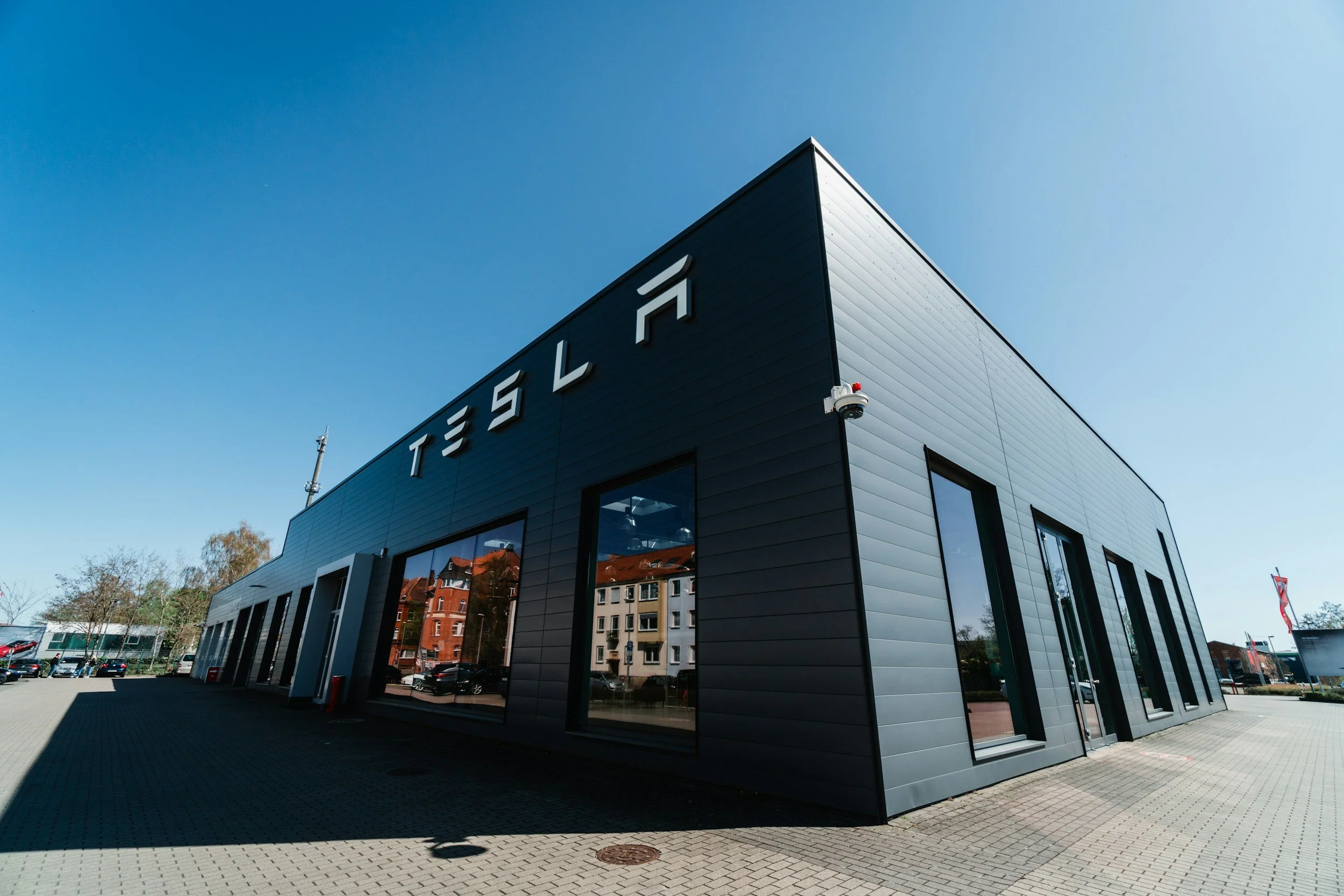
On September 11, Tesla registered a Vietnamese subsidiary on with $3 million in charter capital. For a sales office. The filing authorizes wholesale and retail of cars and parts. It names no launch date, no models, no service network, no factory.
I am going to keep backing VinFast anyway. Let me explain why that is not the compliment it sounds like.
(Yes, I have spent years telling Vietnamese executives to benchmark themselves against the world. Now I am asking you to buy a car I will admit is still not great, because it is ours. Hypocrite noted. The hypocrisy is the point.)
The 98% is a system, not a market share
VinFast delivered 175,099 EVs in Vietnam last year, by its own count, in a market of roughly 180,000. That is the headline. Read the plumbing behind it.
Free charging at V-Green stations runs until June 30, 2027. Zero-down-payment financing and 6 to 10 percent incentives sit on every mass-market model. GSM, the Xanh SM taxi operator, plans to buy about one million EVs from VinFast between 2026 and 2030. V-Green, the charging network, was built mainly for VinFast cars.
VinFast builds the car. GSM buys the car. V-Green charges the car. One family's ecosystem, start to finish.
Efficient? Yes. Tested by customers who had a real alternative? No. Market share you have engineered and market share you have won look identical on a slide. They behave very differently the day a competitor shows up.
Somebody is paying for the loop
VinFast lost 28.1 trillion dong, about $1.1 billion, in the first quarter of 2026. That loss was 58.9 percent wider than a year earlier, on deliveries that grew 61 percent to 58,577. It lost about $3.9 billion in 2025. Cash stood at roughly $209 million on March 31.
Growth is real. So is the bill.
Then came May. VinFast announced it would move its Vietnamese factories to a buyer group led by Future Investment Research and Development JSC, in a deal valued around $530 million, taking about $6.9 billion of debt and obligations with them. VinFast calls the result an asset-light company that is essentially debt-free. Analysts, including YCP's Mehdi Jaouadi, said the strategy makes sense while flagging governance questions around the related-party structure.
Then the family handover. Pham Nhat Quan Anh, 33, became chairman on May 23 and global CEO on September 12, replacing his father, who stays on the board. His brother, Pham Nhat Minh Hoang, now runs GSM globally.
Family succession is not a scandal. Much of Asian industry runs on it. But a 33-year-old inheriting a loss-making, related-party-heavy, subsidy-fed system is the strongest argument yet for putting the company in front of real competition.
Tesla brings a story. Not a threat to volume.
Do not mistake $3 million for a plan to win Vietnam. It is a plan to be present. No service network, no parts supply, no local assembly. Vietnamese buyers already distrust foreign entrants that look like sellers who vanish when something breaks. Tesla just qualified.
Look at Thailand, the region's clearest preview. Japanese brands held about 85 percent of the market before 2022 and 69.3 percent by 2025, taken apart by Chinese makers who built local plants. BYD alone took 38.5 percent of Thailand's battery-electric market in 2024. Tesla ranked sixth. Bangkok's incentive rules oblige importers of discounted EVs to assemble two cars locally for every one imported by December 2026, and three by December 2027.
A fortress cracks when product, policy and local assembly line up. Tesla brings one of the three.
The real threat to VinFast's volume is Geely and BYD at VF 3 and VF 5 prices. Tesla threatens something else: the story.
VinFast spent years selling itself as Tesla's challenger on American soil. It pledged $4 billion to a North Carolina plant. The state says work on the site stopped in December 2024. In May the state sued to take the land back, and VinFast concedes nothing runs before 2028. (VinFast disputes the state's claims and says it will build.) Meanwhile Tesla walked into Ho Chi Minh City with $3 million and no announcement.
One company pledged billions to fight abroad. The other showed up at home with a filing.
The commission was never the product. The car is.
The boldest move in this ecosystem is not Tesla's. It is GSM's.
Xanh SM is offering up to 100 percent revenue share for two years. Read the conditions. The driver must buy or lease a VinFast electric car or motorcycle from September 19, register to operate exclusively on the Green SM platform, and start before December 19.
That is not a price war on Grab. Grab takes a variable fee on each trip. Be, the local rival, keeps a fixed cut of about 24 percent in Ho Chi Minh City and 30 percent in Hanoi. This is a sales funnel. Every driver who takes the deal buys a VinFast and locks supply into one platform. GSM can afford to give up commission because the car pays for it.
Grab is already behind in Vietnam. Mordor Intelligence, as reported, put Xanh SM at 44.7 percent of ride-hailing in 2025. Don't expect Grab to leave quietly, though. Across Southeast Asia it spent $379 million on mobility incentives in the first half of 2026 alone.
Zero commission is not free. Someone funds it: the charging subsidy, a vehicle business with negative gross margins, and in the end a parent's balance sheet.
Back VinFast. Then hold it to the Toyota standard.
The car is better than it was 18 months ago. I will say that in public. The charging network is denser. VinFast counts more than 150,000 charging ports across 34 provinces and 400 service workshops (its own numbers, and the ports include e-scooter charging). Vietnamese engineers built that in under a decade. It deserves backing.
Here is the standard I hold it to, and it is not Tesla's. Toyota did not win Vietnamese families by being exciting. It won by being the car you buy without thinking too much: reliable, cheap to keep running, easy to get serviced, priced for the middle class. Great quality, affordable, accessible. That is the job.
Tesla is expensive. It is not that car. Its arrival tests VinFast's story, not VinFast's customer. The customer VinFast has to keep is the middle-class family, and the rivals for that family are BYD and Geely at VF 3 and VF 5 prices.
Backing is not shielding. A national champion that has never lost a customer to a foreigner has never been tested. So run the Toyota test: is it still cheap to run in year five, are parts and workshops close by, does it hold its value? Win on that, not on free charging that expires in mid-2027.
What it means for Vietnam. The measure of a champion is the middle-class family that could have bought a BYD, a Geely or a Tesla and still chose VinFast in year five. Watch that number, not the market share.
What it means for executives buying fleets or company cars. Your leverage window opens now, while VinFast still has something to prove and rivals are arriving. Negotiate service guarantees and charging access in writing.
What it means for policymakers. The 0 percent registration fee runs to December 31, 2030 for every battery EV, not only the local one. Neutrality will be decided on charging access: open networks or closed ones.
Pride is a fine reason to buy a car once. It is a terrible business model for the second.
— Vietnam Vanguard • Perspective • Cuong Dang
September 26th 2026