
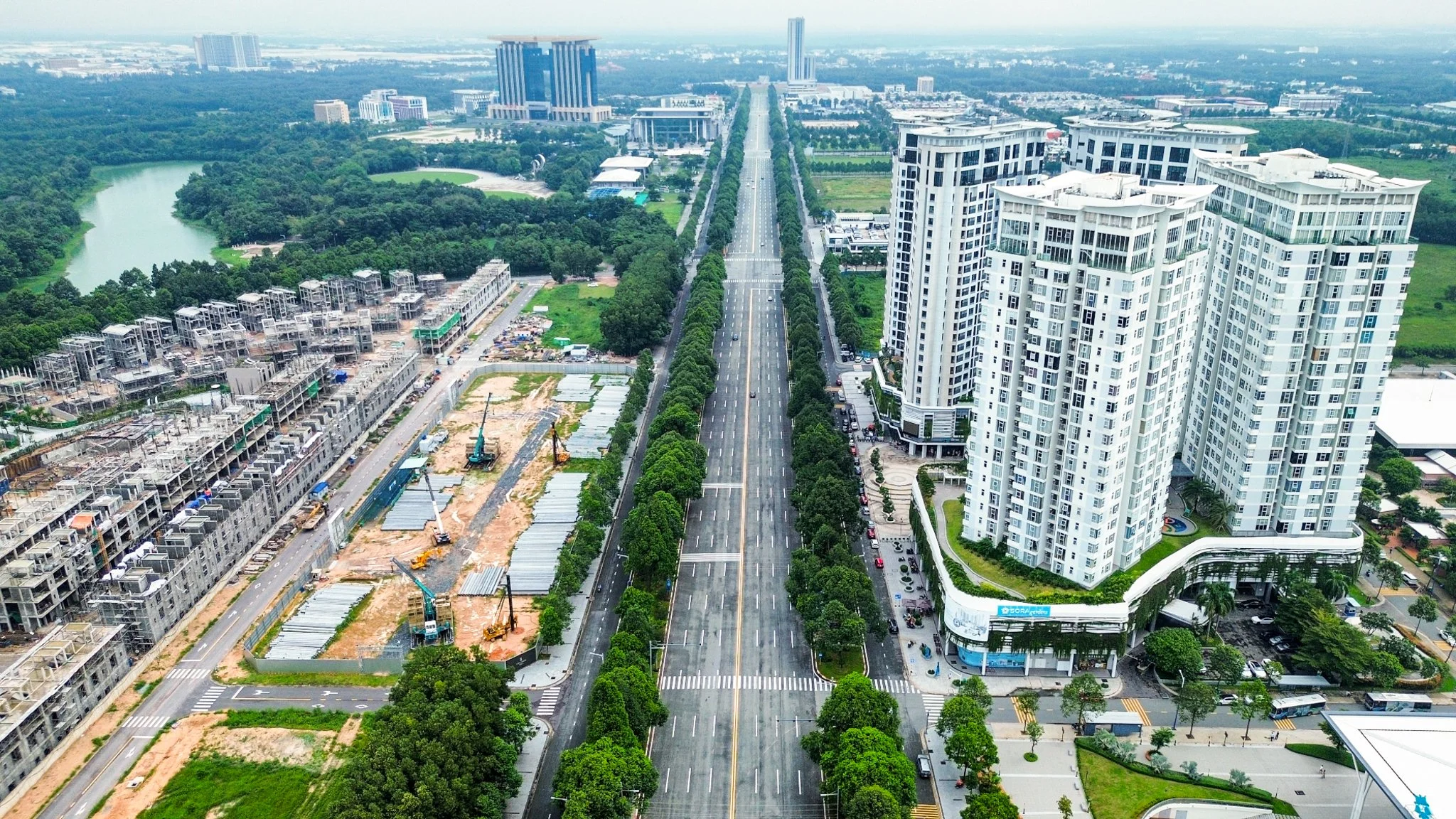
The Capital Shift That Cannot Be Postponed
Vietnam’s next decade will require reallocating capital from mature assets into high-priority infrastructure — and divestment remains the fastest mechanism to close the widening funding gap.
November 27th, 2025
—by Vietnam Vanguard
________________________________________________
For nearly four decades, Vietnam’s development story has followed a clear pattern: remove structural constraints, widen the space for market forces, and let the private sector drive growth. From agricultural liberalization in the late 1980s to major trade reforms and WTO accession, every step in the country’s economic transformation has been tied to expanding participation and reducing concentration.
Thomas Vallely, former Chair of Fulbright University Vietnam and one of the American scholars who has observed Vietnam most closely over the past 30 years, once remarked that the process of “eliminating the State’s monopoly role in the economy” has been the single most important driver behind the making of a modern Vietnam.
Economists like Vallely and Harvard’s Dwight H. Perkins describe Vietnam’s rise as a gradual dismantling of the constraints of a centrally planned system. Agriculture was the first sector to be liberalized, followed by trade and foreign investment. From Đổi Mới in 1986 to the passage of the Foreign Investment Law in 1994, Vietnam shifted from chronic food shortages to becoming one of the world’s largest rice exporters — powering the fastest poverty reduction rate in Asia at the time.
A Reform Playbook Built on Removing Constraints
From the mid-1990s, Vietnam accelerated its integration into the global economy: joining ASEAN in 1997, negotiating the Bilateral Trade Agreement with the United States in 2000, and entering the WTO in 2007. These milestones reshaped the country’s investment environment and attracted the first major waves of FDI from Japan, South Korea, Taiwan, and later the United States.
Parallel liberalization efforts transformed key sectors.
Banking:
Private joint-stock commercial banks emerged — ACB (1993), Sacombank (1991), Techcombank (1993) — standing alongside state-owned banks and creating a competitive credit system. These institutions soon became the principal engine of market-based credit, attracting strategic investors such as: Mizuho → Vietcombank, KEB Hana → BIDV, and SMBC → VPBank.
These deals brought long-term capital, risk management systems, and modern banking technology.
Aviation:
With the end of Vietnam Airlines’ monopoly, Vietjet Air and Bamboo Airways helped the aviation market triple between 2012 and 2019, positioning Vietnam among the world’s fastest-growing aviation markets. Airfares fell sharply, air mobility increased, and mass tourism became a new socioeconomic driver.
Telecommunications:
Market opening in the early 2000s — led by Viettel, FPT Telecom, and private operators — drove service prices down by up to 80% in a single decade, while internet penetration rose from 0.3% to more than 50%. This shift laid the groundwork for a dynamic digital economy, from e-commerce to fintech to online services.
Each wave shared the same logic: reduce concentration, unlock competition, and let private capital build scale.

The Private Sector Needs a New Platform
This long chain of “de-monopolization” reforms created today’s economic architecture: a massive foreign-investment-driven economy, dynamic banking and media systems, and productivity growth of 2.5–3% annually. Yet Vallely notes that the domestic private sector remains the only real source of incremental productivity, especially as labor costs rise and global supply chains shift.
Despite its importance, the formal domestic private sector contributes only 12–15% of GDP — far below China’s 60% and Thailand’s 30%. This gap makes the private-sector orientation of Resolution 57 and Resolution 68 more urgent than ever.
Vietnam’s long-term competitiveness will depend on how effectively the State continues creating space for private enterprise to scale — not only through deregulation, but through strategic capital reallocation.
__________________
The domestic private sector contributes only 12%–15% of GDP — far below regional peers.
__________________

A New Challenge: Mobilizing Capital at Scale
Vietnam’s ambition to join the US$1 trillion club in the 2030s requires a shift in approach. The country can no longer rely solely on the reform logic of the past 30 years. The next stage demands the ability to mobilize and allocate capital at unprecedented scale.
Infrastructure sits at the center of this challenge. It is the platform that enables productivity and scale — and a necessary condition for maintaining growth momentum and policy commitment.
Vietnam’s infrastructure needs for 2025–2030 are estimated at US$245 billion (VIS Rating & CGIF). Yet public investment stands at roughly US$18.7 billion per year.
On November 25, 2025, the National Assembly approved Resolution 245/2025/QH15, outlining a 2026 budget of US$126 billion, up more than 24% from 2025, with a deficit of 4.2% of GDP. Ambitious as this is, the numbers underscore a structural truth: fiscal tools alone cannot close the capital gap.
This is why policymakers have emphasized a consistent message: divestment is not a financial option; it is a structural requirement.
_________________________
Infrastructure needs for 2025–2030 reach US$245 billion. The budget can only cover a fraction.
_________________________
Trần Thanh Mẫn, Chairman of the National Assembly

Divestment: Vietnam’s Largest Untapped Capital Reserve
Divestment achieves three objectives at once:
Frees capital for infrastructure, digital transformation, and energy.
Improves enterprise performance through strategic investors.
Expands the domestic private sector, ensuring broader participation in the next growth cycle.
This is not about shrinking the State’s role.
It is about repositioning it — shifting capital from mature commercial assets toward national priorities that only the State can accelerate at scale.
Vietnam has already shown the capability to execute transformative divestments.
The 2016–2020 cycle delivered landmark transactions:
Sabeco (2017): 53% sold for ~US$4.8B — one of Southeast Asia’s largest deals
Nhựa Bình Minh: SCIC sold 24%
Nhựa Tiền Phong: SCIC sold 29%
Vinaconex: a pivotal precedent for open auction
Viglacera: State ownership reduced from majority to 0% in under nine months
These transactions once signaled the beginning of a new privatization cycle.
Sabeco (2017): 53% sold for ~US$4.8B — one of Southeast Asia’s largest deals
___________________________
From 2021 — 2024, only 15 enterprises completed divestment (5–7% of the planned portfolio)
High Expectations, But a Slower Reality
From 2021–2024, however, progress slowed considerably.
According to the Ministry of Finance’s 2025 SOE restructuring report:
Only 15 enterprises completed divestment (just 5–7% of the planned portfolio)
By number of transactions, completion was under 10%
Budget remittances totaled 657 billion VND, far below expectations
SOEs divested 8.6 trillion VND, but retained most proceeds at enterprise level for debt balancing and internal restructuring
This created a structural bottleneck: divestment is happening, but the State budget does not benefit immediately, limiting fiscal space for large-scale infrastructure investment.
Meanwhile, transactions long watched by the market — such as Becamex IDC, Petrosetco, or long-delayed cases like Hanel — will determine whether momentum can return in 2025–2026.
The slowdown does not reflect weak political will.
It reflects the complexity of aligning:
valuation methodologies
legal procedures
long-term SOE strategies
short-term market appetite
and global capital-market volatility
Why Divestment Matters for Private-Sector Growth
Vietnam’s domestic private sector — the country’s long-term productivity engine — cannot expand without new structural space. When executed transparently and at scale, divestment provides that space.
The pattern is consistent across Vietnam’s post-Đổi Mới success stories:
Capital markets deepen when high-quality assets enter free float.
Governance improves when strategic investors participate.
Local firms scale faster when they can acquire or partner with divested assets.
This logic built modern banking, aviation, and telecommunications.
The next decade requires applying the same logic to logistics, energy, infrastructure operations, and technology-enabled services.
The Strategic Question Ahead
Vietnam is entering a decade where leadership, capital, and institutions must scale together. The foundations that powered the past 30 years — deregulation, market opening, global integration — remain essential but are no longer sufficient on their own.
The next stage of Vietnam’s development will depend on:
how effectively the country can convert state assets into development capacity,
how quickly capital can be mobilized for national priorities, and
how strongly institutions can coordinate to support long-term growth.
Divestment is not merely a financial tool. It is a signal of strategic confidence, governance maturity, and Vietnam’s commitment to building the capital engine required for the future it aims to create.
— Vietnam Vanguard
November 27th, 2025