

Ten Hard Truths About Vietnam's Capital Markets
What the Capital Intelligence Forum 2026 revealed — and what the evidence confirms.
Vanguard’s Briefing • Editorial • Reporting from CIF 2026, Ho Chi Minh City
Vietnam's economic ambition is not in question. The country has built one of Asia's most compelling growth stories, and on 21 September it enters FTSE Russell's Secondary Emerging classification after seven years on the watchlist.
Ambition and investability are not the same thing.
At the Capital Intelligence Forum 2026, leaders from KPMG, SSI, Dragon Capital, HSBC, Hanwha Life, PVI Asset Management, VinaCapital, S&I Ratings, BNY, DBS and the Vietnam Bond Market Association examined what stands between the two. They did not agree with one another. They returned repeatedly to the same constraints: dependence on banks, an absent domestic institutional base, shallow market depth, unreliable pricing signals, and too few companies genuinely prepared to receive institutional capital.
None of this is an argument for pessimism. Vietnam's capital markets are not failing. They are unfinished — and the ten numbers below define what remains.
Each figure is sourced. Each is corroborated by someone who said it on the record, with their name attached.
01. US$53.5 billion against US$2.9 billion
How Vietnam actually finances itself
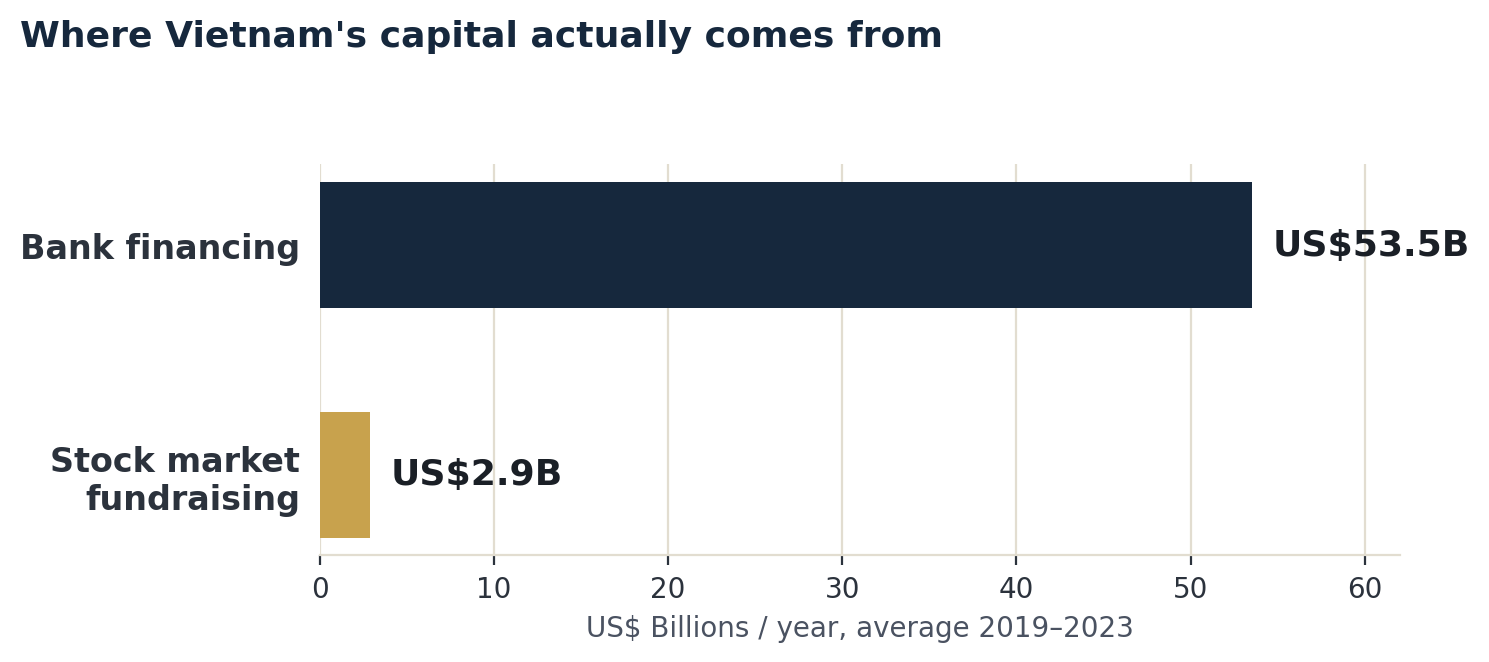
Between 2019 and 2023, Vietnam's economy mobilised an average of US$53.5 billion a year through the banking sector — and about US$2.9 billion a year through the stock market. That is a ratio of roughly eighteen to one, and it is the World Bank's own estimate.
Bank credit reached approximately 136% of GDP in 2024, above most emerging markets, with growth accelerating to 19% year-on-year by June 2025.
Warrick Cleine, chairman of KPMG Vietnam, built his keynote around what that dependence produces. Banks are funded by short-term deposits and lend against tangible security, which means the credit system does not merely finance the economy — it shapes it:
"Credit which is really driven from collateralised lending, that is lending secured by property... you're pushed into property when Vietnam wants you to move into tech or innovation." — Warrick Cleine, Chairman, KPMG Vietnam
Against this, Vietnam's infrastructure requirement alone runs to roughly US$30 billion a year, with a cumulative shortfall of US$94 billion projected between 2019 and 2040. Politburo Resolution 68 tasks the private sector with contributing over 60% of GDP by 2045.
Banks cannot carry that. A deeper capital market is not an alternative to bank credit. It is missing financial infrastructure.
02. 90% of GDP — and US$1.5 billion a year
Market capitalisation is not capital formation
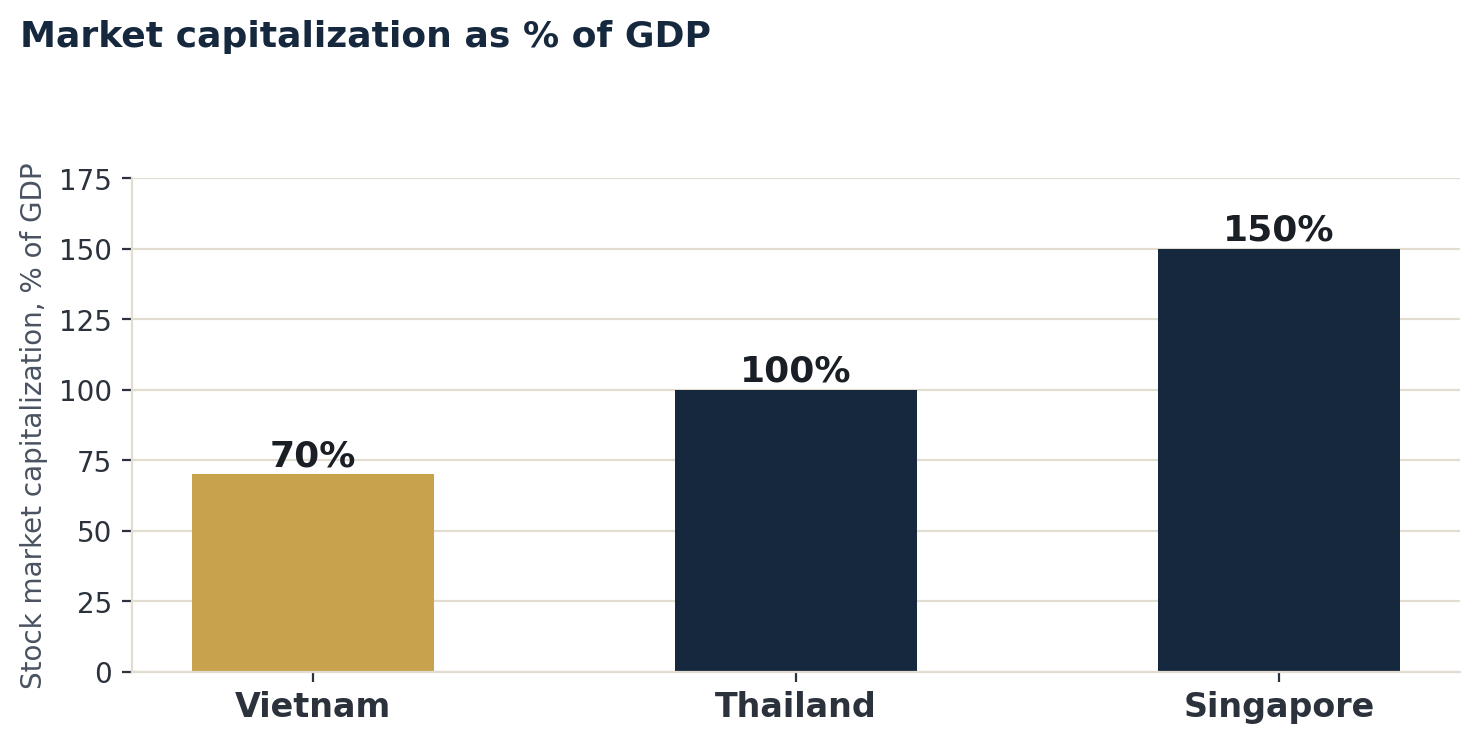
Vietnam's combined capital markets exceeded 90% of GDP by 2023. That number is regularly cited as evidence of maturity. It is evidence of size.
Over the same 2019–2023 period, total equity fundraising across both Vietnamese exchanges averaged roughly VND37 trillion — about US$1.5 billion — a year.
The distinction matters more than almost anything else on this list. A rising index increases the value of shares already in circulation. It does not mean companies are raising new money to build, hire or expand. Vietnam's market has become large at valuing existing ownership and remained small at funding new enterprise.
The real test of an equity market is not what its listed companies are worth. It is how much new capital it channels into productive businesses — and on that measure Vietnam raises less each year than a single mid-sized IPO in a developed market.
03. BB+
Vietnam is not investment grade
In January 2026, Fitch upgraded the rating on Vietnam's long-term senior secured debt to BBB–. The instruments are Brady Bonds issued in 1998, whose principal is collateralised by zero-coupon US Treasuries. In the same action, Fitch stated that Vietnam's sovereign rating was unchanged at BB+. S&P holds Vietnam at BB+ stable; Moody's at Ba2.
The action was widely reported as Vietnam reaching investment grade. It was not.
This matters because the sovereign rating is the ceiling on the cost of capital for every borrower in the country. Hoàng Việt Phương, chief executive of S&I Ratings, placed Vietnam precisely from the stage:
"We are just one notch below the investment grade by Fitch and S&P, and roughly one and a half with Moody's. So it will be a quantum leap if we can move towards the investment grade." — Hoàng Việt Phương, CEO, S&I Ratings
Her assessment of what stands in the way was specific: banking system leverage at 155%, modest foreign exchange reserves, tariff exposure — and, recurring throughout, policy predictability and transparency.
Michael Kokalari, chief economist at VinaCapital, argued the arithmetic is already there:
"When you look at the quantitative criteria, on most of the criteria like government debt to GDP, for example, Vietnam is pretty much already an investment-grade country. We pretty much tick all the boxes." — Michael Kokalari, Chief Economist, VinaCapital
If both are right, what separates Vietnam from an upgrade is not fiscal capacity. It is disclosure, consistency and communication — the cheapest gap on this list to close, and the one that has stayed open longest.
04. Plus 41%, minus US$4.6 billion
Two records, opposite directions, same year
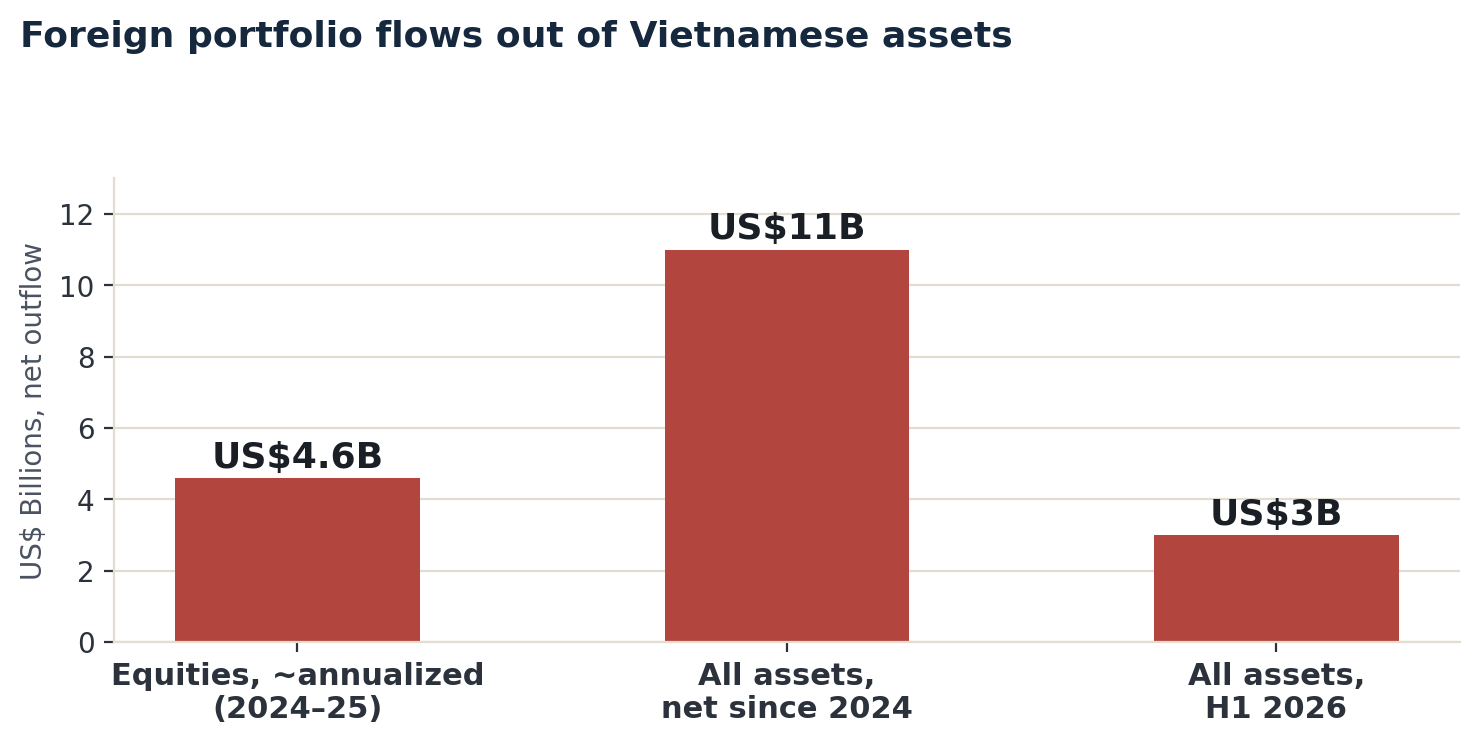
In 2025 the VN-Index rose 40.87%, its strongest year on record. In the same year foreign investors were net sellers of roughly VND121 trillion — about US$4.6 billion — also a record.
The comfortable reading is that domestic conviction has matured beyond needing foreign validation. The evidence does not support the flattering explanation. Hoàng Việt Phương dismissed the obvious one directly:
"It's not about the valuation. If you look at the forward PE for this year, it's around ten times, which is lower than by regional standards. And if you look at the earnings growth for last year, it's 34 percent — the highest level in the last decade." — Hoàng Việt Phương
Cheapness was not the issue. Money left anyway. What remains is composition: roughly nine in ten trades on the Vietnamese market are retail. A retail base operating inside a capital-controlled economy, choosing between deposits, gold and property, is not a price-setter international allocators can benchmark against.
A 41% return achieved without a marginal foreign buyer tells you less about Vietnamese equities than about where Vietnamese savings are permitted to go.
05. In one index, out of the other
Vietnam is being reclassified in two directions at once
On 21 September, Vietnam enters FTSE Russell's Secondary Emerging classification, with inclusion phased across four tranches to September 2027. The World Bank estimates US$3–5 billion of portfolio flows in the first few years, rising toward US$25 billion by 2030 if reform continues.
In June 2026, MSCI published its Annual Market Classification Review. Vietnam was not added to the watchlist. It was not mentioned in any key section of the report. In the same period, two Vietnamese companies were among the largest additions to the MSCI Frontier Markets Index.
Vietnam is simultaneously joining one emerging market index and being reaffirmed as a frontier market by another. Both index providers are looking at the same country.
Kokalari, who called MSCI "the real key," explained why the second door became harder to open — a free-float manipulation episode elsewhere in the region hardened MSCI's scrutiny of exactly the criterion on which Vietnam is weakest:
"We had a window for many years in which it would have been pretty straightforward to get an MSCI upgrade... the window which was wide open for years and years — it will be harder now." — Michael Kokalari
Thomas Nguyen of SSI was blunter about the hierarchy: FTSE is "junior varsity," MSCI is "the varsity team." MSCI reclassification is estimated to carry three to four times the flows of the FTSE upgrade.
He also cautioned against reading too much into September itself. Passive inflows are mechanical: index funds buy because benchmark rules require it, not because they have formed a view. The next credible milestone is the central counterparty system, in testing now and slated for early 2027 — the reform MSCI is most visibly waiting on.
The upgrade opens a door. Vietnam still has to give investors a reason to stay after they walk through it.
06. 19% of GDP, 95% of accounts
The missing domestic institutional base
Assets managed by Vietnamese institutional investors — insurers, pension funds and investment funds combined — amounted to approximately 19% of GDP in 2023, below most regional peers. Domestic individuals hold roughly 95% of securities accounts.
James Lo of DBS in Hong Kong offered the sharpest diagnostic of what that produces. In a single year Vietnam attracted roughly US$5 billion of private capital across 149 deals, including half a billion in early-stage venture — while the public equity market saw outflows of similar magnitude.
Foreign investors have not lost interest in Vietnamese companies. They have lost interest in Vietnamese listed securities. Lo framed the task precisely: converting foreign interest "into some meaningful public equity allocation."
Thomas Nguyen drew the conclusion that runs against instinct:
"As much as we spend talking about attracting foreign money... the reality is, if we don't have that strong pension base, the strong demand base locally, the foreigners won't be that attracted to us. It's almost counterintuitive that the more you want foreign money, the more you should be strengthening your base at home." — Thomas Nguyen, SSI
Ngô Thế Triệu of the Vietnam Bond Market Association explained the mechanism. Foreign capital withdraws when global conditions tighten. What allows it to leave — and therefore what makes it willing to arrive — is the presence of a domestic buyer on the other side of the trade.
Vietnam does not have enough of one.
07. US$88 million
The entire licensed voluntary pension industry
Asked to name a single policy action for the next twelve months, Kokalari answered in two words: "Pension funds."
At the end of 2025, four licensed managers ran seven voluntary pension funds in Vietnam, holding roughly US$88 million between 28,560 participants.
The obvious objection is that Vietnam Social Security manages assets equivalent to around 10% of GDP — larger than every other domestic institutional investor combined. That is true, and it makes the picture worse rather than better. VSS assets sit overwhelmingly in government bonds and bank deposits. Life insurers, the other large pool, are similarly concentrated.
So Vietnam has the savings. What it does not have is any mechanism for converting them into risk capital. Hoàng Hoài Giang of Hanwha Life described the constraint from inside a life insurer's balance sheet:
"For the life insurance company, we have to base on the liabilities in order to make the investment. But unfortunately, in Vietnam, we cannot easily follow that process. Our investment decision is rather market driven rather than the liability driven." — Hoàng Hoài Giang, Hanwha Life Vietnam
Her reasons were specific: not enough long-duration assets, too few good-quality corporate bonds, no functioning secondary market — and regulation "based on the purpose base rather than on the credit risk-based assessment," including mandated allocations to low-yielding government bonds.
On the demand side she was equally direct. Tax incentives for long-term savings, she said, are "very low" — and solving that alone would create "a huge demand."
Ngô Thế Triệu put the latent pool at roughly US$90–100 billion across social insurance and life insurance. Hoàng Việt Phương's own single policy priority pointed the same way: "more actions to increase the weight of the capital market and reduce the weight of the banks."
Compare: India's systematic investment plans channel billions of dollars of new equity capital into the domestic market every month. Australia's superannuation pool exceeds the economy that produced it.
Vietnam is building a capital market without a buyer.
08. Four years — and 60% property
The bond market's real problem is duration and composition, not volume
Vietnam's corporate bond market has recovered from the 2022–23 turmoil. Recovery is not maturity.
The average maturity of Vietnamese corporate bonds is approximately four years, less than half the regional average — against infrastructure assets with twenty-year cash flows. And the composition has shifted back toward exactly where Vietnamese credit has always gone: bank bonds accounted for effectively all corporate issuance in the first quarter of 2025 but only around 30% a year later, while real estate issuers expanded to roughly 60%.
Give the reform its due. Ngô Thế Triệu reported late payments falling from around 12% at the crisis peak to roughly 1%, secondary trading volumes up about 20% year on year, and — for the first time — a visible spread separating well-rated paper from poorly-rated paper:
"Before, the market had no distinction between the good credit rating bond and the not so good one... Now they know exactly which one has the default. At least you see the discipline market." — Ngô Thế Triệu, Optima Wealth Partners / Vietnam Bond Market Association
But the structural gaps remain. Hoàng Việt Phương:
"Over 90% of the bonds now, it's private placement, and there's short, limited information in the Hanoi Exchange without details on the coupon or the payment schedule... The term of the bonds concentrates below five years, and that makes the yield curve more difficult to build." — Hoàng Việt Phương
Without a yield curve, risk cannot be priced. Without pricing, the market cannot deepen. A bond market is not mature because bonds can be issued. It is mature when risk can be assessed, differentiated, priced and traded through a full cycle.
09. Under 2%
Vietnamese wealth is real. It is not institutionally mobilised.
Mutual fund assets run at 20% to 30% of GDP across developed Asian markets. Ranganath Ananth of HSBC put Vietnam's figure at under 2%.
The standard explanation is financial illiteracy. The most useful reframing of the forum rejected it outright:
"Wealth management exists in Vietnam at scale. It's just not institutionalized. It happens at the household level. Putting your money in gold as an alternative — keeping it in dong — is a wealth management decision with a return target and a risk management implication. Buying USDT so you can loop it and earn 4% rather than putting it into a dollar deposit in a Vietnamese bank and earn zero, is equally a wealth management decision." — Will Ross, Dragon Capital
"It's a nation of arbitrageurs. People find value when they have a sense that there's value to be found." — Will Ross
Households are optimising rationally against poor instruments. The failure is on the supply side, and the panel named its components: first-generation founders with capital locked in their own businesses; a preference for assets that feel tangible; products built to protect the seller from mis-selling liability rather than to be understood by the buyer; minimal tax incentive to lock money away; and returns measured against the only hurdle rate Vietnamese savers actually use.
"The hurdle rate in Vietnam for financial investments is deposits. It's not treasuries. It's not inflation. It is deposits." — Will Ross
Ananth argued products alone will not shift this — investors need understandable advice, realistic expectations and education delivered consistently over years, not campaigns. Ross countered that education is the slow instrument and policy is the blunt one, pointing to two inflection points visible across East Asia: tax-advantaged savings plans that restrict early withdrawal, and the ability to invest across the border.
Vietnam does not need more investment products. It needs institutions that earn the right to manage family wealth.
10. US$10 million, and zero
The system rewards collateral over enterprise — and the bridge out was never built
DatVietVAC has operated since 1994 and generates between US$18 million and US$20 million of free cash flow a year. Its total bank borrowing is approximately US$10 million.
"Because we're so light on assets, we do not have real estate on balance sheets... So bank lending is tough for us. This is a company that's been running for 30 years, continuously to be profitable, but it's very tough to raise capital through banks." — Phan Đăng Hùng, Head of Strategy Development, DatVietVAC
That is Truth One expressed as a single company. The businesses Vietnam says it wants next — technology, creative industries, consumer platforms, services — derive value from intellectual property, brands, data and people. If capital keeps following property more readily than productivity, Vietnam will finance yesterday's economy while describing tomorrow's.
There is a second half to this, and it is the sharpest fact of the day. BNY is the world's largest depositary bank for depositary receipts, the standard instrument for reaching the deepest capital pool on earth. Teresa Woo confirmed that no Vietnamese company has ever created one.
"It has yet to be done here. We're looking forward to hoping that one day — between the regulatory environment here, the depository bank, the investment bank, and the DatViets of Vietnam — we help create a bridge to the foreign capital." — Teresa Woo, BNY
The preparation, she noted, is "not dissimilar" to what a domestic IPO already demands: governance, IFRS reporting, a few additional conditions. Meanwhile she described watching Vietnamese listings that "should have been oversubscribed many times" struggle for capital deep enough to sustain them.
The requirements are not mysterious. Credible governance. IFRS-compatible reporting. Independent oversight. Audited accounts. Adequate free float. Clear use of proceeds. Investor relations capability. Consistent disclosure. Minority shareholder protection.
Both DatVietVAC and GELEX Infrastructure described the work involved — board development, Big Four audit, risk management systems, ratings, long-term capital planning. Nguyễn Hoàng Long of GELEX described rebuilding governance from group level down to project subsidiaries over two years, adopting IFRS, obtaining a Moody's assessment, and installing a risk framework reviewed at every board meeting.
Which points to the hardest truth of all, and the one that inverts the entire premise of attracting capital. It was Bùi Quang Duy of responsAbility — a Swiss manager with US$6 billion under management, actively allocating to Vietnam — who said it:
"While there's a lot of demand for capital in Vietnam, it's quite difficult to find the good stuff — good companies that can check the boxes for investors, meeting all of those requirements." — Bùi Quang Duy, responsAbility
The shortage is not always capital. Frequently it is the shortage of companies prepared to receive it on institutional terms.
What these truths add up to
Vietnam's capital markets are not failing. They are unfinished.
The progress is real and it was hard won. Seven years on the FTSE watchlist ended in a reclassification earned through pre-funding reform, a new trading system, lower foreign ownership limits, English-language disclosure required for the first time, and a global broker model. Corporate bond regulation has improved. Mandatory ratings have already removed the most leveraged issuers from private placement.
The next stage is harder than an index classification, because it cannot be delivered by regulation alone. Vietnam has to move:
From bank dependence to diversified financing
From market capitalization to genuine capital formation
From individual speculation to institutional investment
From short-duration instruments to patient capital
From collateral-based lending to enterprise-based financing
From selling products to earning investor trust
From promising opportunity to producing investable issuers
Trịnh Quỳnh Giao of PVI Asset Management framed the whole question in a single line:
"The cost of capital of a country is not just a number. It's the price of trust — in policy, in the law, and also in the enforcement and economic stability." — Trịnh Quỳnh Giao, CEO, PVI Asset Management
She closed her panel with the sentence that should govern the next twelve months:
"It's not about whether Vietnam can reform, but whether it can reform fast enough to fund the growth."
None of these constraints is permanent. That is the optimistic conclusion.
Economic growth alone will not remove any of them. That is the hard one.
Sourcing & Methodology
This article draws on the Vietnam Vanguard Capital Intelligence Forum 2026 transcript — Warrick Cleine's keynote and four panel discussions covering investor confidence, public and private capital, wealth management, and issuer access to global markets. External statistics were verified against World Bank, IMF, FTSE Russell, MSCI, S&P Global Ratings, Fitch Ratings and Asian Development Bank publications. Conference statements represent speakers' own views. Vietnam Vanguard does not provide investment advice; company references illustrate structural questions and are not assessments of any security. Direct quotations are taken verbatim from the recorded transcript. External statistics were checked against primary sources as of July 29, 2026:
World Bank — "A Turning Point for Việt Nam's Capital Markets" (2026) & "Taking Stock: Reaching New Heights in Capital Markets"
IMF — 2025 Article IV Consultation, Vietnam
FTSE Russell — March 2026 Semi-Annual Country Classification Review; confirmed effective date September 21, 2026
MSCI — May 2026 Index Review (Frontier Markets classification confirmed)
S&P Global Ratings — 2026 Asia-Pacific Sovereign Rating Trends (Vietnam: BB+, stable)
Asian Development Bank — AsianBondsOnline, Q1 2026 Vietnam market summary