
Borrowed Time.
Vietnam’s cost of capital has never been lower. Its permitting timelines are what’s pricing out the investors it needs.
Insights from Vietnam 1T SUMMIT — Jan 7th, 2026
— Vietnam Vanguard
The story investors tell themselves about Vietnam usually starts with cost of capital: it's an emerging market, money is expensive, returns need to compensate for that. At Vietnam Vanguard's 1T Summit this year, three investors on the same panel — one foreign, one regional, one domestic — independently described a different problem. Capital in Vietnam is currently about as cheap as it's been in a generation. The thing eating returns isn't the cost of money. It's how long everything takes.
The Cheapest Money in Years
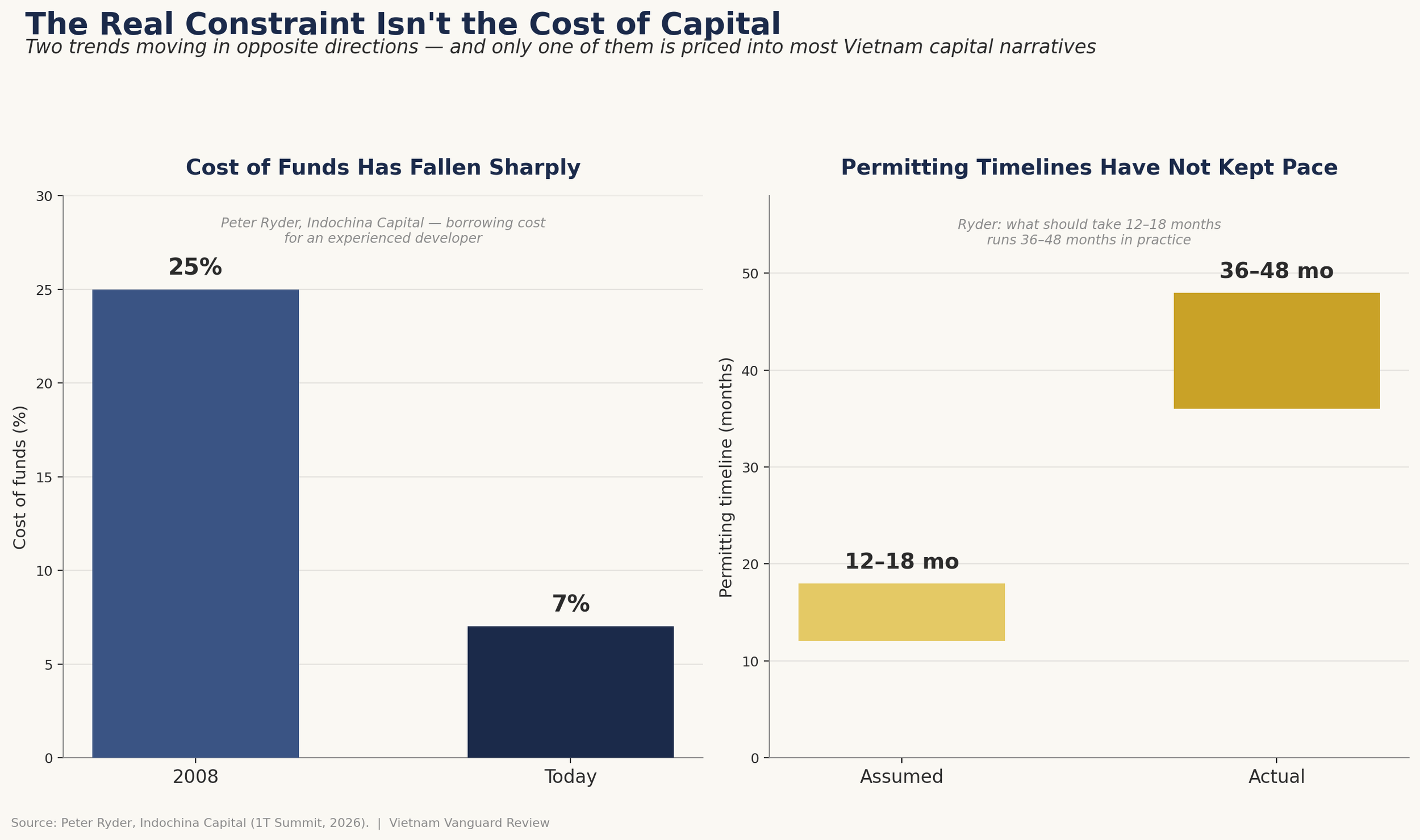
Peter Ryder has been investing in Vietnam long enough to have the historical comparison memorized. Group Executive Chairman of Indochina Capital, he estimates he and his team have brought $3 to $4 billion of foreign capital into the country, principally into real estate. "Cost of funds right now in Vietnam, for us at least, as an experienced, reasonably well-reputed investor developer, is probably at its lowest point. We're borrowing today at around 7%. I can go back — I remember, back in 2008, it was costing us 25%."
That's not a marginal improvement. It's a structural shift in how cheap domestic borrowing has become for a credible operator, and it should, on paper, make Vietnam more competitive for capital than it's been in Ryder's career here.
So Why Can He Barely Clear 15%?
It doesn't, because the return math isn't primarily a function of financing cost. "Honestly, we're lucky if we can underwrite new projects today at 15%," Ryder said. "You can get more than that easily in Europe, in the Americas, in other parts of Asia. So from my perspective, the biggest challenge to attracting the next wave of capital — domestic or foreign — is to make the investment process here much easier, because it is the time value of money that's killing one's return. What should take 12 to 18 months, unfortunately, here will take 36 to 48 months."
Run that through a standard IRR model and the mechanism is obvious: a project that clears a healthy return on an 18-month approval timeline can slide toward mediocre on a 40-month one, without a single input assumption changing. Cheap debt doesn't fix that. Neither does investor sentiment. The clock itself is the cost.
"Honestly, we're lucky if we can underwrite new projects today at 15%. You can get more than that easily in Europe, in the Americas, in other parts of Asia. So from my perspective, the biggest challenge to attracting the next wave of capital — domestic or foreign — is to make the investment process here much easier, because it is the time value of money that's killing one's return. What should take 12 to 18 months, unfortunately, here will take 36 to 48 months."
Peter Ryder, Executive Chairman
Indochina Capital

Two Independent Voices, Same Diagnosis From Different Angles
Nirukt Sapru, Chairman of Jardine Matheson Vietnam, framed the same underlying issue through sovereign risk pricing rather than project timelines. Vietnam currently sits one notch below investment grade with both S&P and Fitch, and two notches below with Moody's — independently confirmed; the government has a formal Ministry of Finance-led program targeting investment grade by 2030. Sapru's point: "If you reduce the risk of doing business in Vietnam, the cost of capital comes down... any area where you make it easier to do business, more efficient, better infrastructure, quicker to export something because the port is better run — all of that reduces the risk premium." Different mechanism than Ryder's permitting timeline, same conclusion: the constraint is execution risk, not capital scarcity. Sapru added a second, more specific point — that financial services and infrastructure, the two sectors most attractive to foreign capital, are also the two where foreign ownership caps push international investors toward the sidelines, since "international investors don't like minority investing."
Trinh Quynh Giao, CEO of PVI Asset Management — a domestic institutional investor, not a foreign one — corroborated the pattern from the bond market side. PVI AM is among the most active local bond investors, and even so, "most of the term that we invest in is only five years. Some bonds we can go maximum seven, but it's mainly for bank bonds." For genuine long-duration capital — the 10-to-30-year money infrastructure actually needs — she was blunt: "the legal framework in Vietnam, to be honest, is not ready yet. If something happens, how do you settle the collateral? It's not there yet." Bond default recovery rates, she noted, have improved from roughly 19% in 2023 to somewhere in the 30s now — real progress, and still low enough that long-tenor capital stays cautious.

“If you reduce the risk of doing business in Vietnam, the cost of capital comes down... any area where you make it easier to do business, more efficient, better infrastructure, quicker to export something because the port is better run — all of that reduces the risk premium.”
Nirukt Sapru, Chairman
Jardine Matheson Vietnam
What Actually Connects the Three
None of the three ever used the word "trust" or "efficiency" the same way, but the diagnosis converges: Vietnam does not currently have a shortage of capital willing to enter the market, and — per Ryder's own numbers — it may have the cheapest domestic financing conditions in over a decade. What's missing is the machinery that lets that capital move at the speed and with the legal certainty international and institutional money needs to convert a low cost of funds into an acceptable risk-adjusted return. That's an approvals-process and legal-enforcement question, not a monetary-policy or investor-sentiment one — which also means it's a more solvable problem than "Vietnam needs cheaper or more abundant capital" would suggest, because the capital is already there and already inexpensive.
The Read
For developers and operators: underwrite Vietnam projects on realistic timeline assumptions, not headline approval windows. The gap between the 12-18 month process on paper and the 36-48 month process in practice is, per Ryder's own portfolio experience, the single largest lever on realized IRR — larger than financing cost swings the market has seen in years.
For institutional and foreign investors evaluating entry: the sovereign rating trajectory is a genuine, trackable signal — Vietnam is closer to investment grade than at any prior point, with a formal government program targeting 2030. An upgrade would compress the risk premium across the board, independent of any single project's execution risk.
For policymakers: the reform lever with the highest near-term return isn't cost-of-capital policy — it's approval-process speed and legal-enforcement reliability on collateral and contract disputes. Vietnam has already made real progress on rating trajectory and bond-market recovery rates; closing the permitting-timeline gap Ryder describes would do more for realized returns, and therefore for future capital inflows, than any plausible change to the cost of money itself.
Insights from Vietnam 1T SUMMIT — Jan 7th, 2026
— Vietnam Vanguard