
The Great Vietnamese Seller Cull
Insights from 1T SUMMIT — Jan 7th, 2026
— Vietnam Vanguard • Editorial • August 24th, 2026
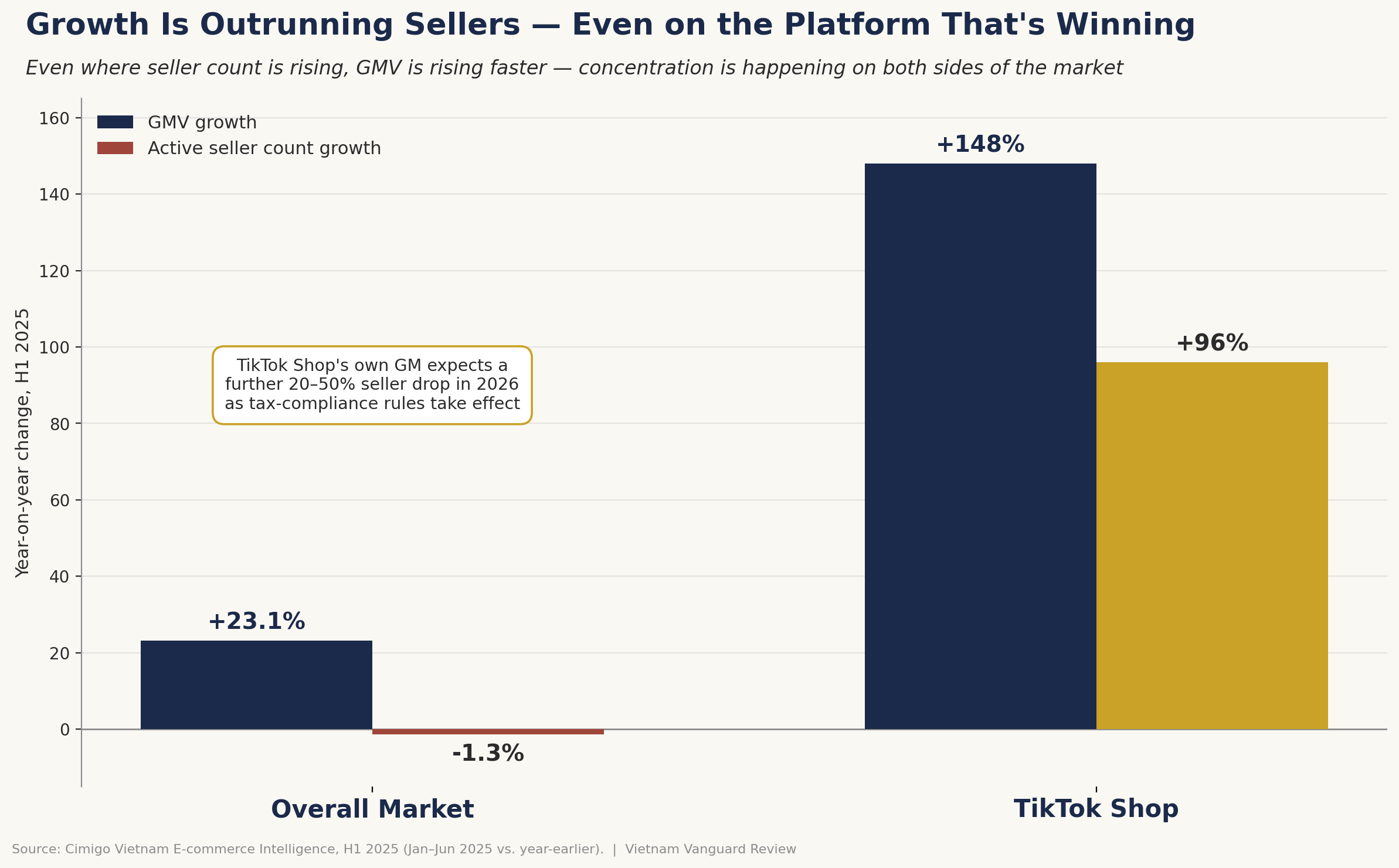
At Vietnam Vanguard's 1T Summit earlier this year, Nguyen Lam Thanh who runs TikTok Technologies Vietnam predicted something that would sound like a threat coming from almost anyone else describing their own platform's user base: "Many small, 'busy' sellers will step out of the market, but professional ones will be very successful. Even if the total number of players drops by 20% to 50%, the professional ones will lead."
Two Platforms, 97 Percent
Vietnam's e-commerce sector has consolidated into a near-duopoly faster than almost anyone predicted three years ago. Shopee and TikTok Shop together controlled roughly 97% of the four major platforms' combined GMV through 2025 and into 2026 with Shopee holding somewhere in the low-to-mid 50s by share, TikTok Shop having surged from the low 30s to over 40% in under two years. The other side of that ledger is brutal: Tiki's revenue reportedly fell around 80% during 2025, and Sendo effectively exited general e-commerce altogether, relaunching in March 2026 as "Sendo Farm," a narrower agricultural-products play. What was a four-platform market three years ago is now a two-platform market with two also-rans.
Thanh's own numbers, on the winning side of that consolidation: 70 million users, 40 million e-commerce buyers, 6 million content creators, 600,000 advertising customers, and GMV that's "over $10 billion" and roughly doubling year over year. Independent tracking corroborates the direction if not the exact multiple — TikTok Shop's Vietnam GMV growth has been reported anywhere from 83% to over 140% year-on-year across different measurement windows in 2025, all pointing to the same story: TikTok went from a distant second to Shopee's near-equal in roughly two years.
The Seller Count Was Already Shrinking Before the Rules Bit
Here's the detail that makes Thanh's forecast more than a talking point: it's already visibly happening, and it started before the compliance wave he's describing had fully landed. Independent platform data for the first half of 2025 showed the number of revenue-generating sellers across the market falling roughly 1.3% year-on-year overall, even as GMV kept climbing double digits, while the count of active sellers specifically on TikTok Shop grew 96% over the same period. Put those two numbers together and the pattern is unmistakable: the market wasn't just consolidating around platforms, it was already consolidating around sellers within the winning platform, months before the regulatory mechanism Thanh is describing had teeth.
What's Actually Forcing the Exit
"From this year, the most important thing is compliance," Thanh said — and he's referring to a specific, dated set of rules, not a vibe shift. Vietnam's E-commerce Law, taking effect through 2026, ends seller anonymity outright: Article 21 requires every seller to submit full identification or business-registration data to the platform and publicly display it, closing off the informal, unregistered listing that a large share of small sellers have relied on for years. Decree 70/2025/ND-CP, effective from mid-2025, goes further upstream — platforms themselves are now required to withhold and remit VAT and personal income tax on sellers' behalf before payouts land, turning every platform into an unpaid extension of the General Department of Taxation. A further rule taking effect from July 2026 adds a consumer whistleblower incentive, a cash reward of up to 10% of any penalty collected, for reporting sellers who fail to issue proper e-invoices. None of this is ambiguous or slow-rolled. It's a deliberate, dated closing of the gap between "selling online" and "being a registered, tax-compliant business," and it lands hardest on exactly the sellers Thanh is describing: small, informal, "busy", in his word, and unprepared for it.
The Uncomfortable Math Behind the Growth Numbers
This is where the story gets more interesting than "regulator improves market quality." If a fifth to half of Vietnam's e-commerce sellers exit in 2026 specifically because they were operating anonymously or off the books, then some real share of the GMV growth that's made Vietnam one of Southeast Asia's most-cited digital-economy success stories was generated by supply that was never going to be durable. That doesn't make the headline numbers false. It does mean the growth curve investors have been underwriting was partly built on participants who are now being formally priced out — and the post-shakeout growth curve, running through a smaller, more concentrated, more compliant seller base, is a structurally different and more reliable number to underwrite going forward, even if it's a smaller one in the near term.
TikTok isn't ignoring the transition cost. Thanh mentioned a program to upskill 10,000 SMEs specifically to help them sell compliantly on TikTok Shop — a real, if partial, answer to a real, if undiscussed, question: what happens to the informal-economy sellers who don't make the cut. That's less a Vietnam-specific footnote than the private-sector mirror of the same formalization trade-off playing out across the economy this year — real efficiency gains, with a transition cost that mostly lands on the smallest, least-resourced participants.
What This Means
For platform and consumer-tech investors: the duopoly is close to settled, and the growth story going forward is less about total seller count and more about GMV-per-compliant-seller — a genuinely more investable metric than headline GMV, since it strips out the churn-prone informal supply that's exiting anyway.
For brands and D2C companies selling through these channels: the professionalization Thanh is describing raises the floor for credible market entry — a compliant, well-run storefront now competes against a shrinking pool of informal rivals rather than a flood of them, which is a genuine tailwind for anyone already operating properly.
For policymakers: the tax-compliance framework is doing exactly what it was built to do — closing a real VAT and PIT collection gap in a fast-growing part of the economy — and the more useful question for 2026 isn't whether to soften it, but whether platform-led transition support, like TikTok's own upskilling program, can scale fast enough to keep the sellers worth keeping.
Insights from 1T SUMMIT — Jan 7th, 2026
— Vietnam Vanguard • Editorial