
Vietnam Needs $200 Billion a Year. Its Financial Center Might Take Twenty.
Insights from Vietnam 1T SUMMIT — Jan 7th, 2026
— Vietnam Vanguard
Vietnam has given itself five years to hit double-digit GDP growth and thirty years to build the institution meant to help pay for it. Those two clocks do not run at the same speed, and nobody presenting the International Financial Center to investors this year has said so directly.
_________________________________
The Decree Is Real. The Timeline Problem Is Bigger Than the Decree.
On December 18, 2025, the government issued Decree 323/2025/ND-CP, the implementing framework for the National Assembly's Resolution 222 establishing Vietnam's International Financial Center. Prime Minister Pham Minh Chinh launched it three days later, on December 21, with two hubs — Ho Chi Minh City for capital markets, banking, and fintech; Da Nang for green and offshore finance. Eight decrees, a dedicated court, an international arbitration center. On paper, it is one of the more complete IFC launches attempted in the region.
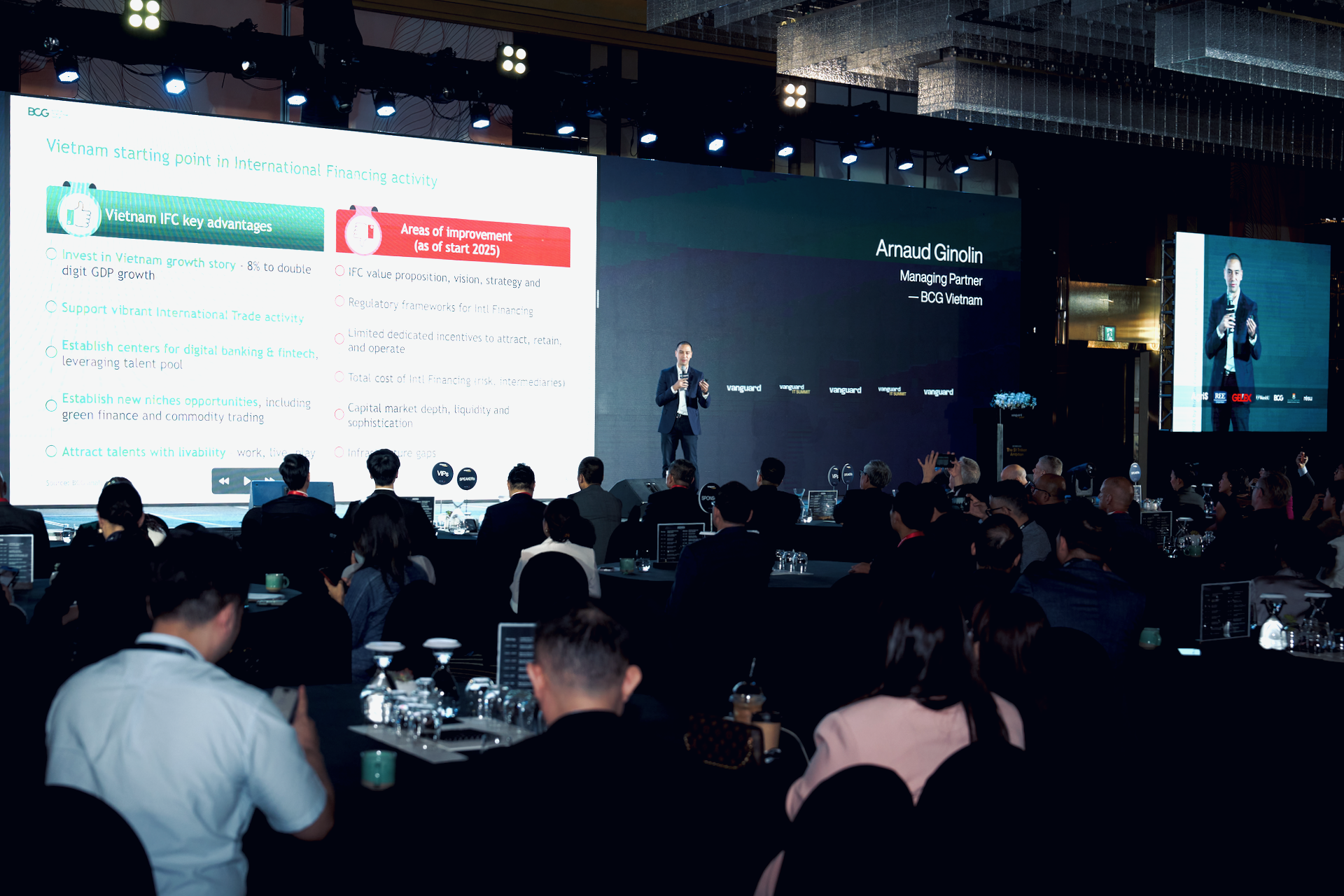
The rationale is not subtle. As Arnaud Ginolin, BCG's Managing Partner for Vietnam, told the room at Vietnam Vanguard's 1T Summit this year: for every dollar of GDP growth, Vietnam needs roughly three to five dollars of financing. Get to a trillion-dollar GDP ambition and you are talking about $1 trillion to $2.5 trillion of cumulated financing by 2030. Domestic bank credit is already stretched. The state budget has limits. That leaves international capital as the only pool large enough to matter — which is the actual reason the IFC exists. Developing Vietnam's financial sector is, in Ginolin's own framing, the second-order goal. The first-order goal is financing growth that is already underway.
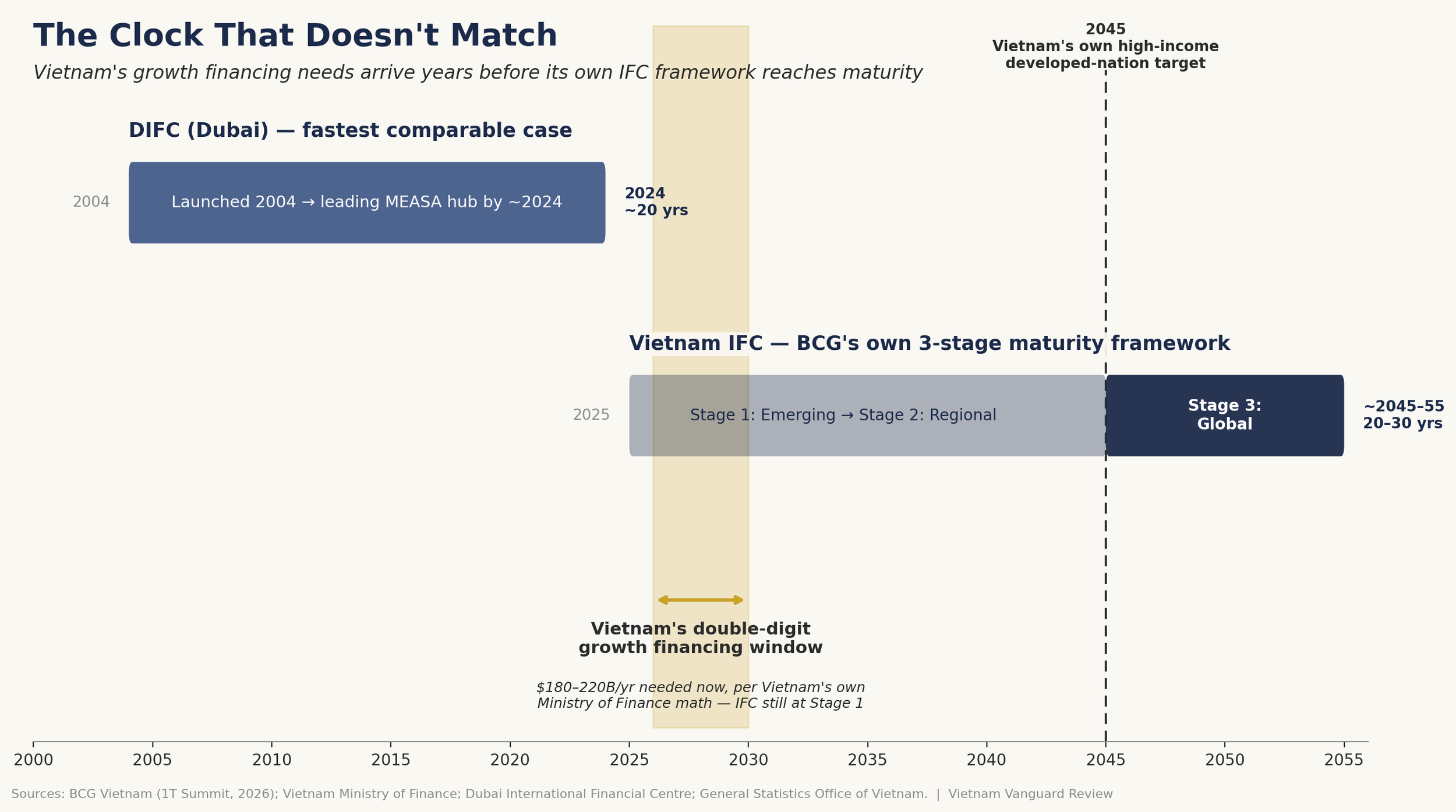
Here is the part that didn't get said out loud: Ginolin's own firm's framework puts Vietnam at the very first of three IFC maturity stages — emerging player, doing mostly domestic financial activity with a little inbound international financing. Getting to "rising star" status, where the center serves neighboring markets, is one jump. Getting to full global IFC — the tier that actually moves the kind of capital Vietnam says it needs — is, in BCG's own words, a twenty- to thirty-year journey.
The Fastest Comparable Case Took Twenty Years — With Every Advantage Vietnam Doesn't Have
Dubai is the standard the region uses whenever fast-track financial centers come up in the room, and it's worth being precise about what "fast" actually meant there. The DIFC was announced in 2002 and opened in 2004, backed by a single-ruler decision structure, its own common-law legal system and independent courts from day one, deep oil-wealth capital behind it, and no domestic banking sector to protect from competition. Two decades later, it has grown into the leading financial hub across the Middle East, Africa, and South Asia — and DIFC is still adding new offerings today, most recently a global centre for family offices and ultra-high-net-worth individuals, to keep expanding its relevance. Twenty years in, the institution that built the fastest is still building.
Vietnam's IFC has none of DIFC's day-one advantages — it operates inside an existing legal system rather than a bespoke common-law carve-out, inside a live domestic banking sector, and inside a one-party consensus process rather than a single ruler's signature. If BCG's own maturity framework is right, and DIFC's own twenty-year run is the fast case, Vietnam's IFC reaches "global" tier somewhere past 2045 — which happens to be the same year the government has separately set as its own deadline for high-income developed-nation status. The institution built to help fund that target won't be operating at the scale needed to fund it until after the target date has already passed or failed.
The Government's Own Numbers Say the Gap Bites This Decade, Not Next
This is where the story stops being about the IFC at all and becomes about arithmetic Vietnam's own Ministry of Finance has already published. To hit 10% GDP growth in 2026, the Ministry estimated Vietnam needs total social investment of roughly VND 4.93 quadrillion — about 33% to 33.7% of GDP — and that figure assumes investment efficiency improves. Vietnam's Incremental Capital-Output Ratio, the standard measure of how much investment it takes to generate a unit of growth, averaged 6.43 over 2021–2025. The government's own target for 2026–2030 is to bring that down to 4.5–4.8. If it doesn't improve, the Ministry's own calculation is that hitting the same growth target would require social investment approaching 70% of GDP — a number nobody treats as achievable.
Vietnam is already behind on the version of this plan that assumes things go well. As of June 30, 2026, national public investment disbursement stood at 35.5% of the annual target, with the Ministry itself flagging that 25 central-level agencies and 11 localities were running below the national average pace. GDP growth in the first half of 2026 came in at 8.18%, accelerating to 8.39% in the second quarter — strong, and still short of the 10%+ trajectory the government needs to sustain through 2030.
None of that is an IFC problem. It's an execution and capital-efficiency problem, and it is happening now, inside the current five-year plan, while the institution meant to help solve the longer-run financing gap is still at stage one of a multi-decade build.
What This Actually Means
For capital allocators evaluating Vietnam exposure: the IFC is a legitimate long-horizon signal — regulatory intent, dedicated courts, sandbox licensing — but it is not the mechanism that will move the growth-financing needle before 2030. The more decision-relevant numbers right now are ICOR trajectory and disbursement rate, both of which are public, both of which are currently running behind the government's own targets. Price the next five years off those, not off the IFC launch.
For the policymakers and advisors architecting the IFC: the framework BCG presented is honest about the twenty-to-thirty-year timeline; the public narrative around the IFC generally is not. A financing institution being built for a 2045-and-beyond payoff should be marketed as exactly that — a long-duration institutional asset — rather than implicitly bundled into the urgency case for 2026–2030 growth targets it structurally cannot yet serve.
The IFC may still be the right multi-decade bet. But Vietnam does not have a multi-decade problem sitting in front of it this year — it has a financing and execution problem that starts showing up in disbursement data before the IFC's first regional-tier milestone would even be due.
Insights from Vietnam 1T SUMMIT — Jan 7th, 2026
— Vietnam Vanguard