
Vietnam's Wind Farms Need $17 Billion. Its Contracts Aren't Built to Raise It.
Insights from 1T SUMMIT — Jan 7th, 2026
— Vietnam Vanguard
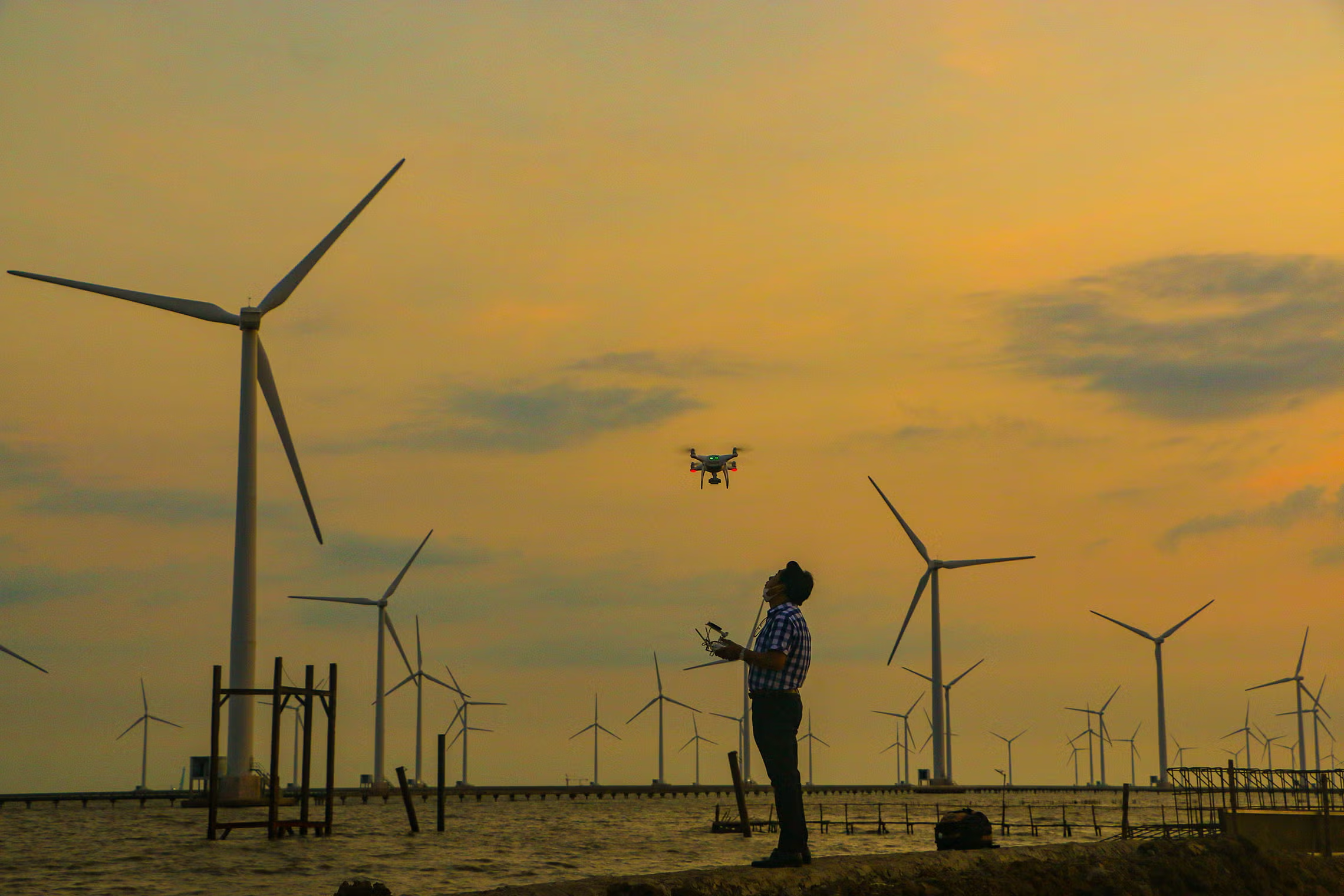
The Bac Lieu wind power plant in southern Vietnam’s Bac Lieu province has a capacity of nearly 100MW. The offshore wind plant has so far provided more than 1.1 billion kilowatt-hours to the national grid. (Photo by Duy Khuong – VNA)
Vietnam's renewable energy sector has a financing model that works, right up until it doesn't. Local banks are comfortable underwriting solar and onshore wind because they know the counterparty — Vietnam Electricity, EVN — and they know the credit risk. That comfort is precisely the problem lurking inside Vietnam's own power plan, because the next phase of that plan is a kind of project domestic banks have never financed, at a scale domestic liquidity was never built to cover.
A Target Six Times the Size of Anything Built Before
The revised Power Development Plan 8 (PDP8), approved by the Prime Minister in April 2025, commits Vietnam to roughly doubling installed power capacity by 2030 — from about 90 gigawatts today toward a range as high as 235 gigawatts, driven overwhelmingly by renewables. Inside that target sits a specific, newer bet: 6 gigawatts of offshore wind, a technology Vietnam has never built at commercial scale before. S&P Global Energy has put a number on what that requires — as much as $17 billion in project financing, an order of magnitude beyond what local banks financed to build out Vietnam's entire existing solar and onshore wind fleet.
Hanh Nguyen, who develops renewable projects for REE Energy, describes the mechanics plainly: project fundamentals — wind speed, solar radiation, output modeling — are the foundation of any investment decision, and incentives are enabling conditions rather than the core issue. The real constraint is what happens once a project actually needs financing. "Local banks are happy to bank on [the current PPA structure]. They're very familiar with the government and EVN credit risk," she notes — a system that has worked because it never had to satisfy anyone outside Vietnam's own banking relationships. Offshore wind changes that. At the scale PDP8 requires, "we will run out of local liquidity for power projects," and the shift to international financing runs straight into a contract structure that international lenders don't consider financeable at all.

"Local banks are happy to bank on [the current PPA structure]. They're very familiar with the government and EVN credit risk."
Hanh Nguyen, Project Development Director
— REE Energy
"Unbankable" Isn't a Newly Invented Word
This isn't a single developer's complaint. Legal and project-finance analysts covering Vietnam's power sector have used the same word repeatedly and independently: Vietnam's Model PPA — the standard contract template wind and solar developers are offered — has been described by lawyers advising international lenders as "unbankable... to a broad spectrum of international banks." The specific gaps are exactly the ones Nguyen names: no guaranteed minimum offtake level, no termination protections, no FX indexation. International project finance is built on the principle that each commercial risk sits with whoever is best positioned to manage it. By that standard, Vietnam's current PPA places several of the risks that matter most to a foreign lender — revenue certainty, currency exposure, early-termination exposure — on the wrong side of the table, or leaves them undefined entirely.
That gap has been visible for a while and hasn't been ignored. A World Bank-backed roadmap for Vietnam's offshore wind sector explicitly calls for transitioning to a competitive PPA and seabed-leasing system by 2026, and for revising the terms of the existing feed-in tariff specifically to make it bankable. Vietnam's own regulatory pipeline for 2026 includes amendments to the 2024 Electricity Law targeting offshore wind and renewable energy certificates, alongside new decrees aimed at clarifying the legal framework investors have been waiting on. The direction of travel is toward exactly the fix international lenders are asking for. The open question is whether that fix lands before the capital actually needs to be raised — Vietnam's own target date for both is the same year.
The Version of This Story Vietnam Has Already Lived Once
Vietnam has, in fact, already run a smaller version of this exact experiment, with a cleaner result. A generous feed-in tariff introduced in 2011 drove almost 4,000 megawatts of onshore wind capacity into operation by 2021, entirely financed through the local banking relationships Nguyen describes — proof that Vietnam's power sector can mobilize real capacity quickly when the incentive and the financing model are aligned. Offshore wind is a different asset class at a different price tag, requiring a different kind of capital than the one that built the last wave. The 2011 FiT boom is the encouraging precedent. The unbankable Model PPA is the reason it may not repeat itself on schedule this time without the contract-level fix landing first.
None of the three protections international lenders are asking for — guaranteed offtake, termination cover, FX indexation — are exotic asks. They're standard terms in project-finance markets everywhere else these projects get built. What determines whether Vietnam's 6-gigawatt offshore wind target arrives on the PDP8 timeline isn't wind speed or turbine availability. It's whether a specific piece of contract language gets rewritten before the $17 billion has to start moving.
Insights from 1T SUMMIT — Jan 7th, 2026
— Vietnam Vanguard