
The REIT Vietnam Never Built Is Already Running — From Singapore
September 10, 2026
— Vietnam Vanguard • Editorial
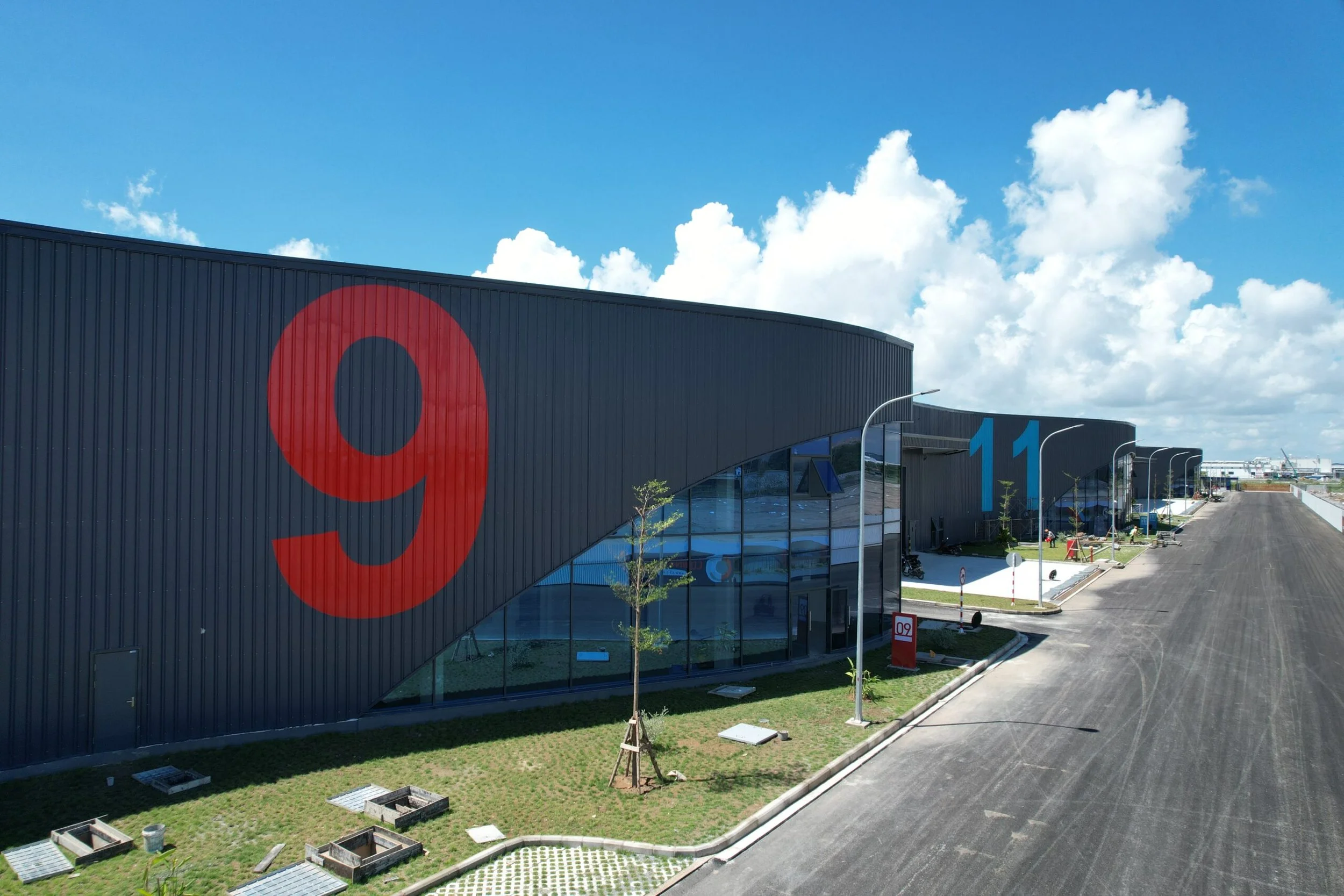
Photo: Core5 Factory Village Hai Phong project located in the DEEP C 2 Industrial Zone within the Đình Vũ - Cát Hải Economic Zone in Haiphong, Vietnam — developed by Indochina Kajima Development (a joint venture between Indochina Capital and Japan's Kajima Corporation).
Vietnam has spent fifteen years failing to build a REIT market. In that time, foreign-listed funds simply built one for themselves — out of Vietnamese warehouses. Mapletree Logistics Trust and Daiwa House Logistics Trust now hold Vietnamese industrial assets inside vehicles listed on the Singapore Exchange, collecting rental income that Vietnamese regulation has made it structurally impossible for a Vietnamese fund to pass through the same way.
The capital-recycling infrastructure this market needs already exists. It's just domiciled somewhere else, and the rent is landing in someone else's shareholders' accounts.
The Market Outgrew the Instrument
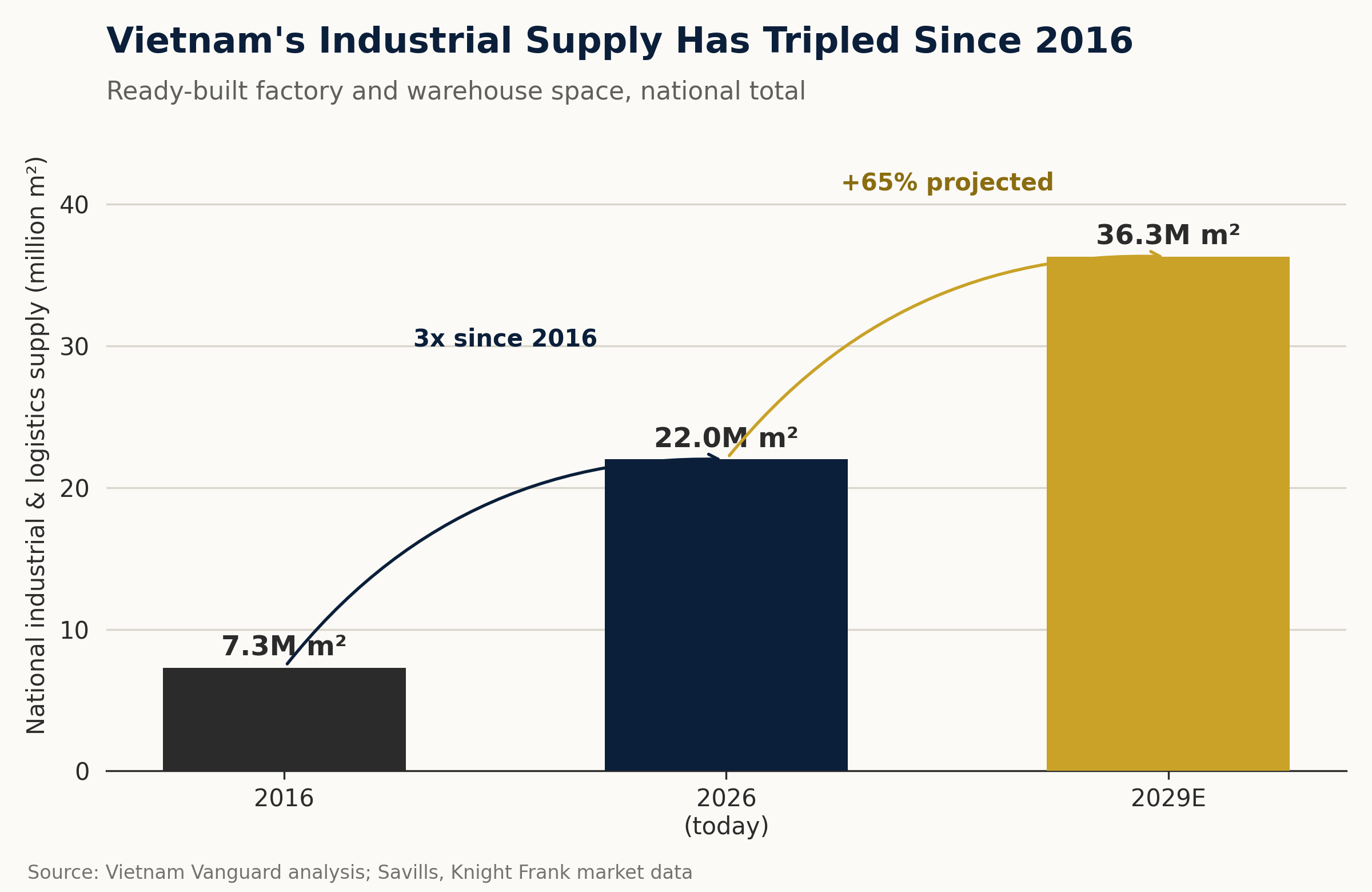
The scale of the problem shows up in the underlying numbers first. In the Southern part of Vietnam alone, industrial land supply has grown roughly 80% over the past decade; ready-built factory (RBF) and warehouse (RBW) space has grown 130–140%, pushing national supply past 22 million m². In the southern economic zone, RBF supply runs 6.8 million m² and RBW 6.6 million m², both above 90% occupancy; the north sits at 5.6 million m² of RBF, above 86% occupancy. Supply has tripled since 2016 and is projected to grow another 65% over the next three years, with the number of investors in the segment up five-fold since 2018 — what Knight Frank's Alex Crane calls the "shining light" in the market by investment volume.
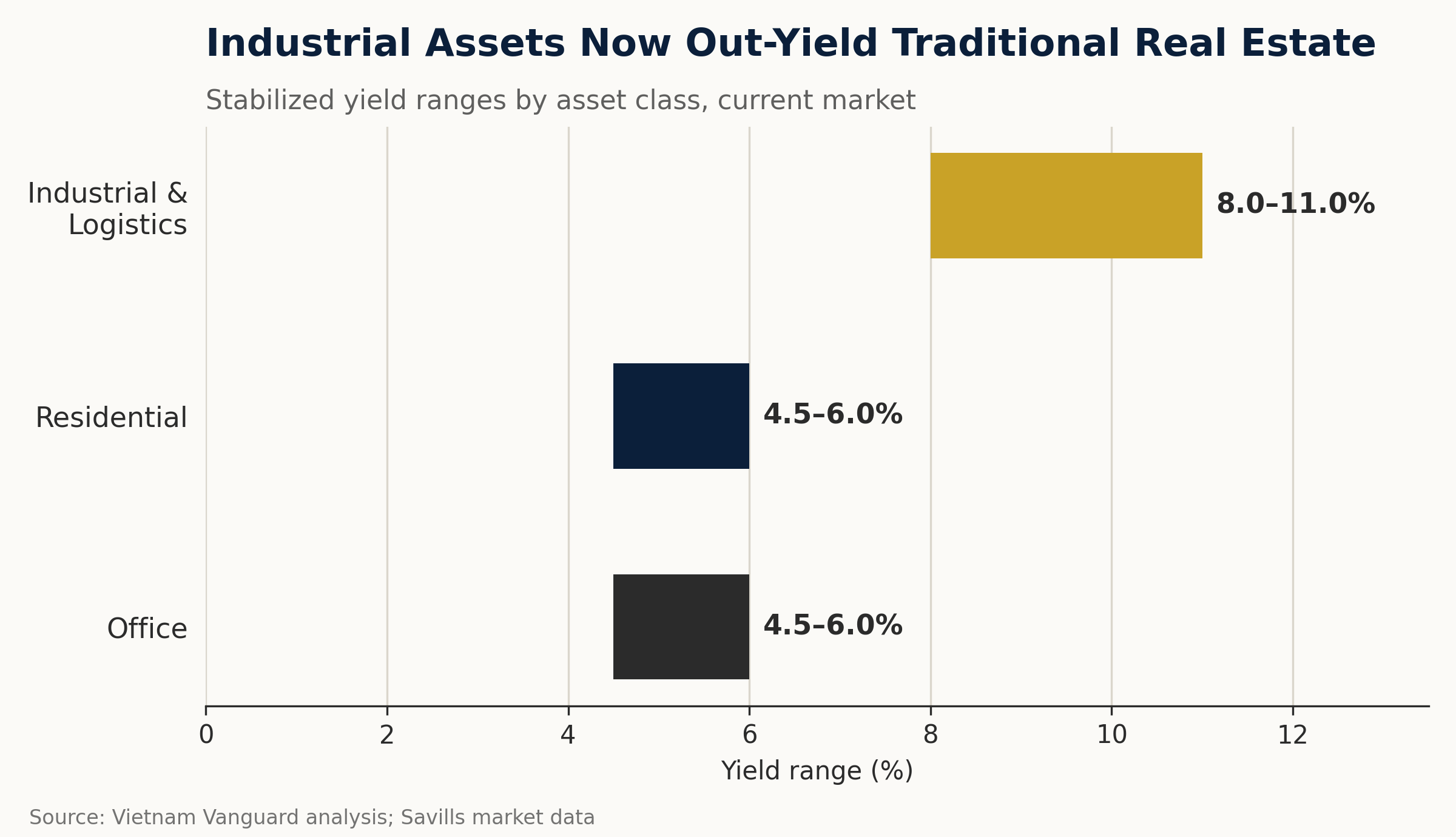
Savills' Neil MacGregor frames the underlying shift: Vietnam has moved past attracting capital purely on cost, toward higher value-added manufacturing, electronics, and logistics deep in the global supply chain. The commercial logic is straightforward — ready-built space cuts 9–18 months off deployment time and 60–70% off initial CAPEX, which is why 62% of new FDI projects now choose to lease rather than build. Yields on the completed asset base run 8–11%, against 4.5–6% for residential or office. This is no longer a frontier asset class; it behaves like an institutional one.
Two Developers, One Bottleneck
Institutional behavior creates an institutional problem: assets mature, and someone has to recycle the capital out. Two of the market's larger portfolios are already running into this, on different terms but the same constraint.
Becamex IDC and Warburg Pincus have built a $3.8 billion, 4.4-million-m² industrial portfolio (BWID) now actively shopping for an exit. Indochina Capital and Kajima's Core5 Vietnam platform, backed by $1 billion in committed capital, has already sold part of its portfolio to Japan's Hulic once occupancy cleared 95%.
Both are examples of the same math: private M&A deals in this asset class take 9–18 months, require $50–100 million minimum tickets, and cost 2–3% of asset value to execute. That ceiling, not FDI appetite or land supply, is what's now constraining how fast the market can turn assets over.
On the ninth floor of Indochina Plaza Hanoi, Michael Piro sits above a piece of the city that once looked like a wrong bet. When Indochina Capital developed the complex nearly two decades ago, Xuan Thuy and the roads around Pham Hung were still construction sites and unfinished infrastructure, with relatively little commercial activity. Today Cau Giay is one of the city's defining new urban districts, its towers and corporate campuses stretching westward, and the Loop Mall, the retail concept now occupying the complex's commercial ground, has become something of an icon in its own right.

Michael Piro
— Co-CEO, Indochina Capital
Piro has watched that trajectory before, which is part of why he's betting on it again. The capital he raises today is chasing assets even further from Vietnam's traditional centers such as industrial parks, logistics facilities, and the infrastructure around them, and he describes the underlying trend as a shift in what investors want: fifteen years ago, capital came to Vietnam chasing 15–20% development returns; increasingly, it now wants stabilized assets yielding 8–10% — a maturing market, in his view, without a matching capital-markets instrument. It's worth naming plainly that Piro's own fund has a direct stake in that instrument existing: a working REIT market would cut Indochina Capital's own exit costs and timelines on its next asset, the same problem it has now solved twice privately. That doesn't make the underlying constraint less real — the same 9–18 month, $50M+ ceiling applies to Becamex and Warburg Pincus's $2.5 billion portfolio, which has no relationship to Vanguard or Indochina Capital at all, but it's the difference between citing him as an expert practitioner and treating him as a disinterested one.
The Instrument Vietnam Actually Built
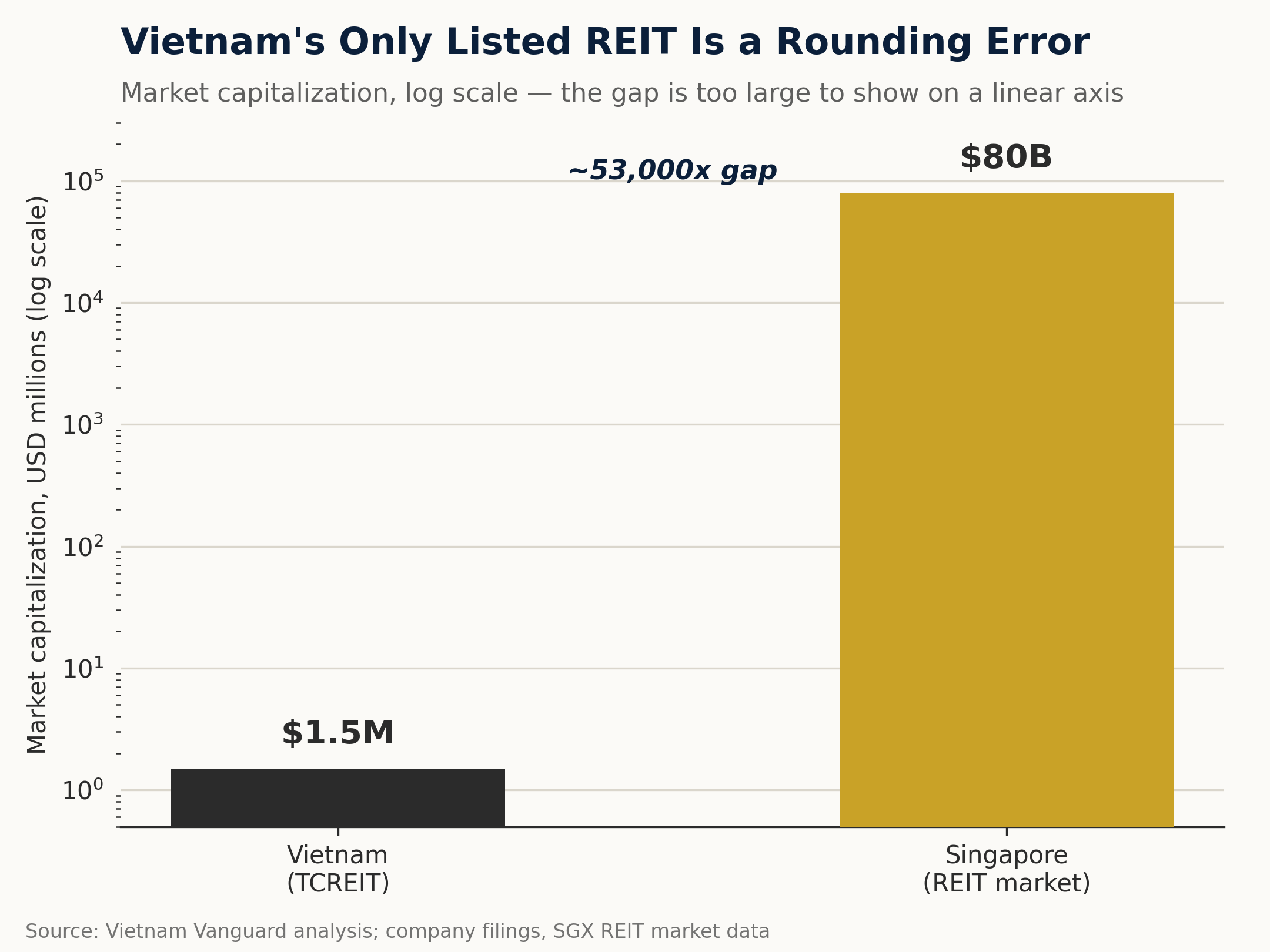
The legal basis for REITs has existed since Decree 58/2012/NĐ-CP — thirteen years before this article. The result is TCREIT (FUCVREIT, Techcom Capital), the only listed product carrying the label. Its market cap: VND 37.5 billion, under $1.5 million, against Singapore's USD80 billion REIT market.
In Q2 2026, TCREIT held 0% investment real estate; more than 86% of its capital sat in shares of listed developers — KBC, VHM, VIC, NLG. That is not a REIT. It's a closed-end equity fund wearing a REIT label, holding no physical assets and distributing no rental income.
Four Barriers, One Regulatory Choice
Duane Morris Vietnam's Oliver Massmann has mapped why this keeps failing, and the barriers compound rather than stack. Vietnamese law has no common-law "trust" concept, so a REIT-labeled product defaults to a mutual-fund wrapper with none of a REIT's leverage tools or asset-governance structure.
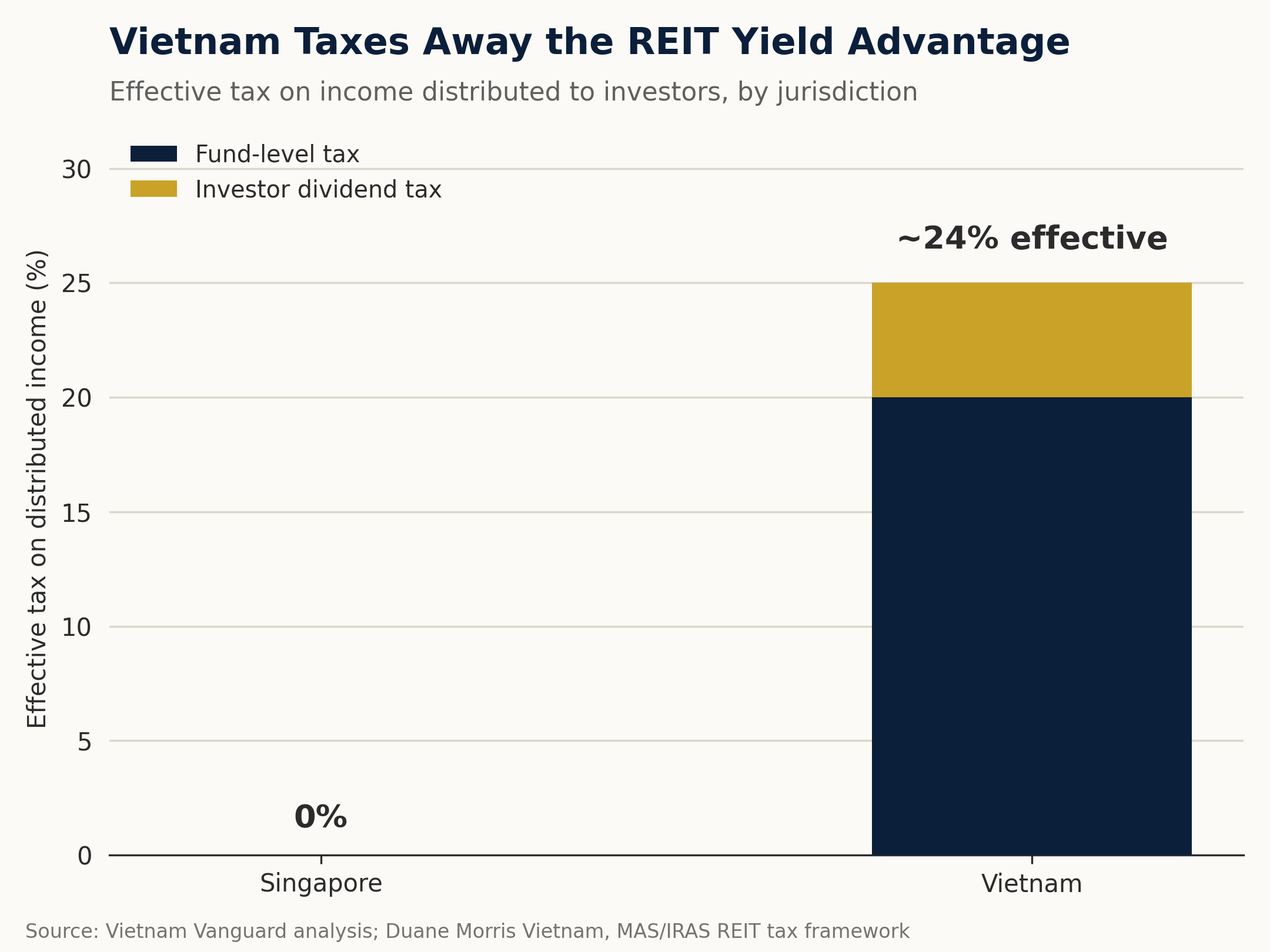
Singapore exempts REITs from corporate tax if they distribute 90% of income; Vietnam taxes fund income at 20% and investor dividends again at 5%, erasing the yield advantage that makes the structure worth building.
Typically, industrial land is a 50-year leasehold, not freehold, multiplying due-diligence complexity. And the natural long-horizon buyer, pension and insurance capital, is regulated out before it can participate: Vietnam Social Security holds roughly VND 1.29 quadrillion, restricted almost entirely to government bonds and state bank deposits; life insurers face investment limits that practically push them the same direction; voluntary pension funds remain too small to matter.
Four technical gaps, read together, are one decision repeatedly made: every rule that would let capital exit a stabilized asset and recirculate has been left unbuilt, while every rule keeping capital parked in low-yield, state-directed instruments has been reinforced.
Where the Capital Actually Went
Capital doesn't wait for the decision to get corrected, it routes around it. Daiwa House Logistics Trust bought an industrial asset near Ho Chi Minh City in 2024 on a 20-year lease. Mapletree Logistics Trust has been acquiring Vietnamese warehouses on the same model, packaging them into a Singapore-listed REIT. According to Indochina Capital's Michael Piro, this fund structure could account for up to 15–20% of real estate market capitalization in mature markets and recycle tens of billions of dollars annually. Vietnam supplies the underlying assets to that cycle and captures none of the multiplier.
Decree 85/2026/NĐ-CP, effective May 2026, is the first real crack in the wall, it lets supplementary pension funds move into listed securities and lowers the mandatory government-bond floor. It's a genuine signal. It is not yet a fix: voluntary pension AUM remains too small to create meaningful REIT demand on its own.
What This Means
For developers and investors: the exit multiple you're underwriting today assumes private M&A at 9–18 months and $50M+ tickets, the same math both BWID and Core5 have had to run. That ceiling isn't moving until Vietnam builds a real REIT wrapper, which means the realistic near-term alternative is the one Mapletree and Daiwa House are already using: structure for a Singapore-listed exit rather than wait for a domestic one.
For policymakers: the tax-transparency fix (ending double taxation at the fund level) is the single highest-leverage lever here, it doesn't require rebuilding trust law or land tenure, and it's the one change that would let capital already inside Vietnam start behaving like REIT capital. Every year it stays unfixed, more of the country's industrial rental income gets securitized abroad instead of at home.
Vietnam didn't fail to attract the assets. It failed to build the exit. Singapore built one instead, using Vietnamese buildings. The country that finally builds a working REIT wrapper won't just fix its own market, it will own the region's.
September 10, 2026
— Vietnam Vanguard • Editorial