

Vietnam's Missing Middle: The Same Gap Behind a 13% Retail Ceiling and a Rice Discount
Insights from Vietnam 1T SUMMIT — Jan 7th, 2026
— Vietnam Vanguard
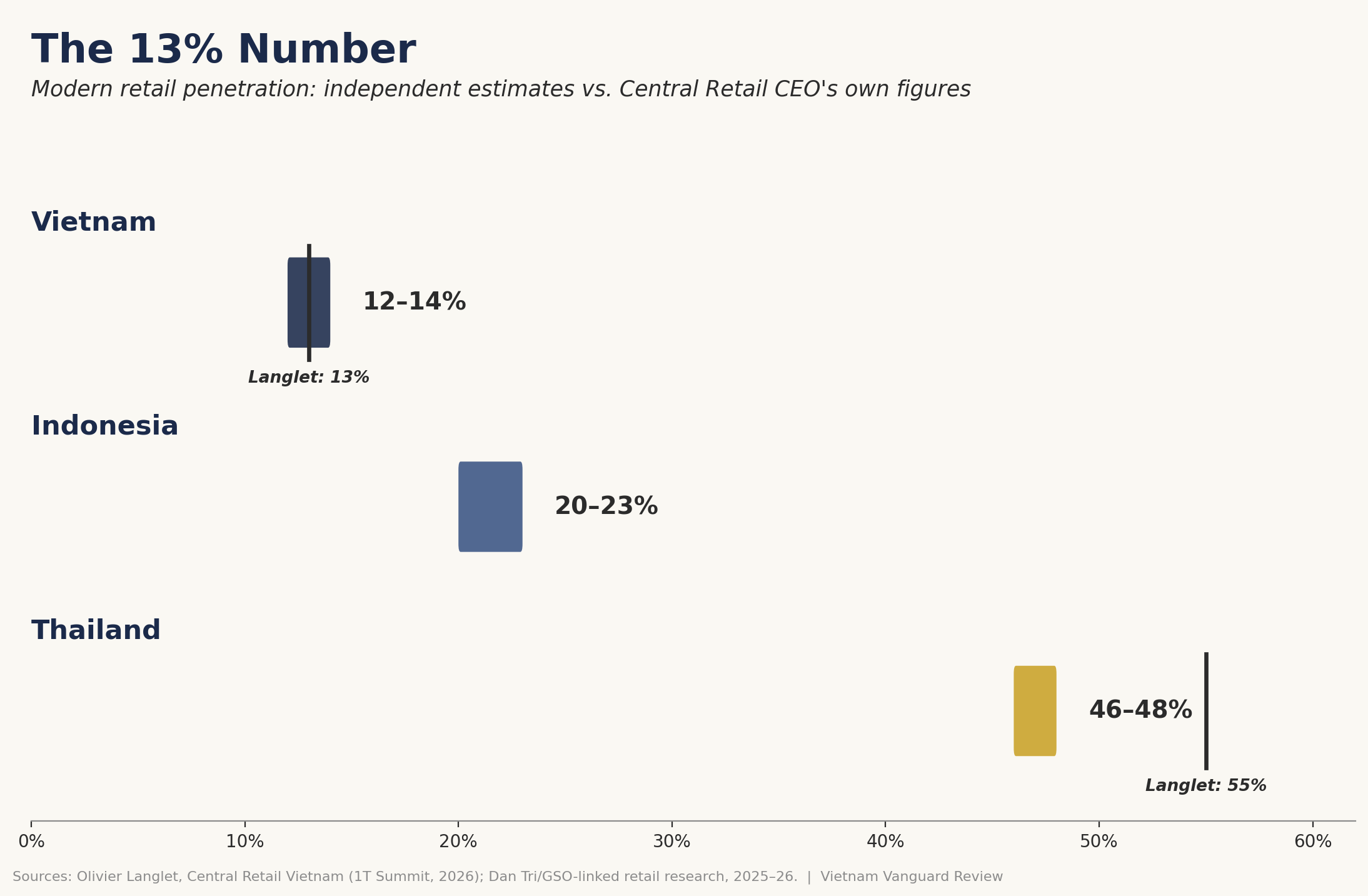
Vietnam produces some of the best rice, lychees, and shrimp on earth, and sells most of it at commodity prices. The coastal country also has 100 million consumers and a fast-growing middle class, and only 13% of retail spending flows through modern channels such as supermarkets, convenience chains, and organized retail against 55% next door in Thailand. Two numbers, two different markets. Same missing layer underneath both.
The 13%
Olivier Langlet runs Central Retail Vietnam with 360 stores, both food and non-food, one of the largest modern retail footprints in the country. At Vietnam Vanguard's 1T Summit this year, he put the gap in plain terms:
"There will not be a 'modern Vietnam' without strong modern retail, yet penetration is only 13% here. There is a long way to go to reach the 55% level of our neighbor, Thailand."
That gap matters more than a retail-sector statistic usually would, because accelerated domestic consumption is one of the pillars Vietnam is explicitly counting on to sustain double-digit growth through 2030. A consumption story with a supermarket penetration rate stuck in the teens is a consumption story with a ceiling on it, and not because Vietnamese households aren't spending, but because a large share of that spending still runs through channels that don't scale, don't standardize pricing or quality, and don't generate the formal transaction data that draws in further retail investment.
Independent estimates put Vietnam's modern trade penetration in a similar range, commonly cited between 12% and 14%, against roughly 46–48% in Thailand and low-20s in Indonesia, depending on methodology and which channels get counted as "modern." The exact percentages move depending on the source; the order of magnitude doesn't. Vietnam is running a full generation behind its two closest regional comparables on the one piece of infrastructure that turns population size into predictable consumer revenue.
The Rice Paradox
Ask Langlet whether Vietnam can export physical products successfully and the answer isn't about market access or tariffs.
"You have amazing products here, some of the best commodities. The best rice in the world is here, but unfortunately, you don't always know how to pack it, supply it, or market it abroad."
He mentioned seeing lychees in a French supermarket, priced high, sourced from somewhere else, "It's a pity because Vietnam has the best lychees."
The pricing data backs the complaint up. As of early August 2026, Thai 5% broken rice was trading at roughly $450–$454 a ton on export markets. Vietnamese rice of comparable grade has spent most of 2026 trading $50 to $100 a ton cheaper — in the $360–365 range for stretches of the first quarter, versus Thailand's $410-plus over the same window. Thailand's premium aromatic varieties, sold under the Hom Mali (Jasmine) name, fetch $800 to $1,200 a ton — two to three times the price of generic white rice of similar quality. That's not a production gap. Vietnam is, by volume, one of the two or three largest rice exporters on the planet. It's a branding, consistency, and traceability gap, and buyers pay accordingly.
Langlet's own operation is investing against exactly that gap, for exactly the reason you'd expect a retailer to: "We work with agro-engineers who go directly to farmers to explain how to harvest, size, calibrate, and pack to ensure traceability is compliant, not just for three days, but for 365 days. As soon as farmers understand the real expectations of the global customer, you can gain market share everywhere." Central Retail sources 95–96% of its roughly 60,000 SKUs domestically. When Vietnamese production quality or consistency slips, in his words, "it impacts modern retail immediately" — the same supply chain that feeds a hypermarket shelf in Ho Chi Minh City is the one that would need to feed a premium export order.
“Vietnam has amazing products here — some of the best commodities. The best rice in the world is here, but unfortunately, we don't always know how to pack it, supply it, or market it abroad.”
Olivier Langlet, Group CEO
Central Retail Vietnam

The Missing Middle
That's the connective thread: modern retail penetration and export price realization are both downstream of the same underdeveloped layer — the quality-consistency and traceability infrastructure that sits between the farm gate and either a supermarket shelf or a shipping container. Vietnam doesn't have a production problem. It has a middle-layer problem: calibration, grading, cold chain, certification, and the kind of farmer-level technical support that turns raw agricultural output into something a retailer or an export buyer can price at a premium and stake their own brand on.
This is also, usefully, a private-capital problem rather than only a policy one. Central Retail is already building part of the fix through its own agro-engineering investment. Sunwah Group is doing something adjacent on the branding side — Jesse Choi mentioned partnering with Vietnam's Ministry of Agriculture on a "Vietnam Pavilion" for e-commerce in China, specifically to build trust with Chinese buyers around Vietnamese-origin products. Neither is a sector-wide fix. Both are proof that the gap is investable, not just aspirational — which is a more useful frame for capital than "Vietnam needs better agricultural policy."
What This Actually Means
For consumer and retail investors: the 13% penetration figure isn't a reason to discount the Vietnam consumption thesis — it's the reason the thesis has a long runway left. Retailers who can solve the supply-consistency problem for their own shelves, the way Central Retail is attempting to, capture share disproportionate to store count, because reliable supply is the actual bottleneck, not consumer demand.
For agricultural exporters and processors: the price gap between Vietnamese and Thai rice, or between Vietnamese lychees at the farm gate and French supermarket prices for someone else's lychees, is closable with investment in traceability and consistency — not with higher production volume, which Vietnam already has in abundance.
For policymakers and institutions building the next phase of agricultural trade support: the highest-leverage move isn't a new subsidy program — it's making certification, cold-chain financing, and traceability digitization easy enough to adopt that a farmer or a mid-sized exporter can actually clear the bar, the way Central Retail's agro-engineers are already doing at their own commercial scale. Vietnam has the raw material for a much bigger version of this story. What's missing is the middle.
Insights from Vietnam Vanguard 1T SUMMIT — Jan 7th, 2026
— Vietnam Vanguard