

Skip the Fab
Vietnam's own semiconductor executives — not outside skeptics — are telling the government to skip the industry's most expensive, most prestigious stage and focus on the two where the country already has a foothold.
Insights from 1T SUMMIT — Jan 7th, 2026
— Vietnam Vanguard
Every country currently chasing semiconductor investment eventually pictures the same thing: a fabrication plant, the multibillion-dollar clean-room facility that actually etches chips onto silicon. It's the version of the industry that shows up in government press releases and CHIPS Act headlines. At Vietnam Vanguard's 1T Summit this year, the two people in the room who actually run semiconductor operations in Vietnam — Le Quang Dam of Marvell Technology and Nguyen Ba Quynh of Hitachi Digital Services — independently steered the conversation away from that picture entirely.
Four Stages, One That's Off the Table
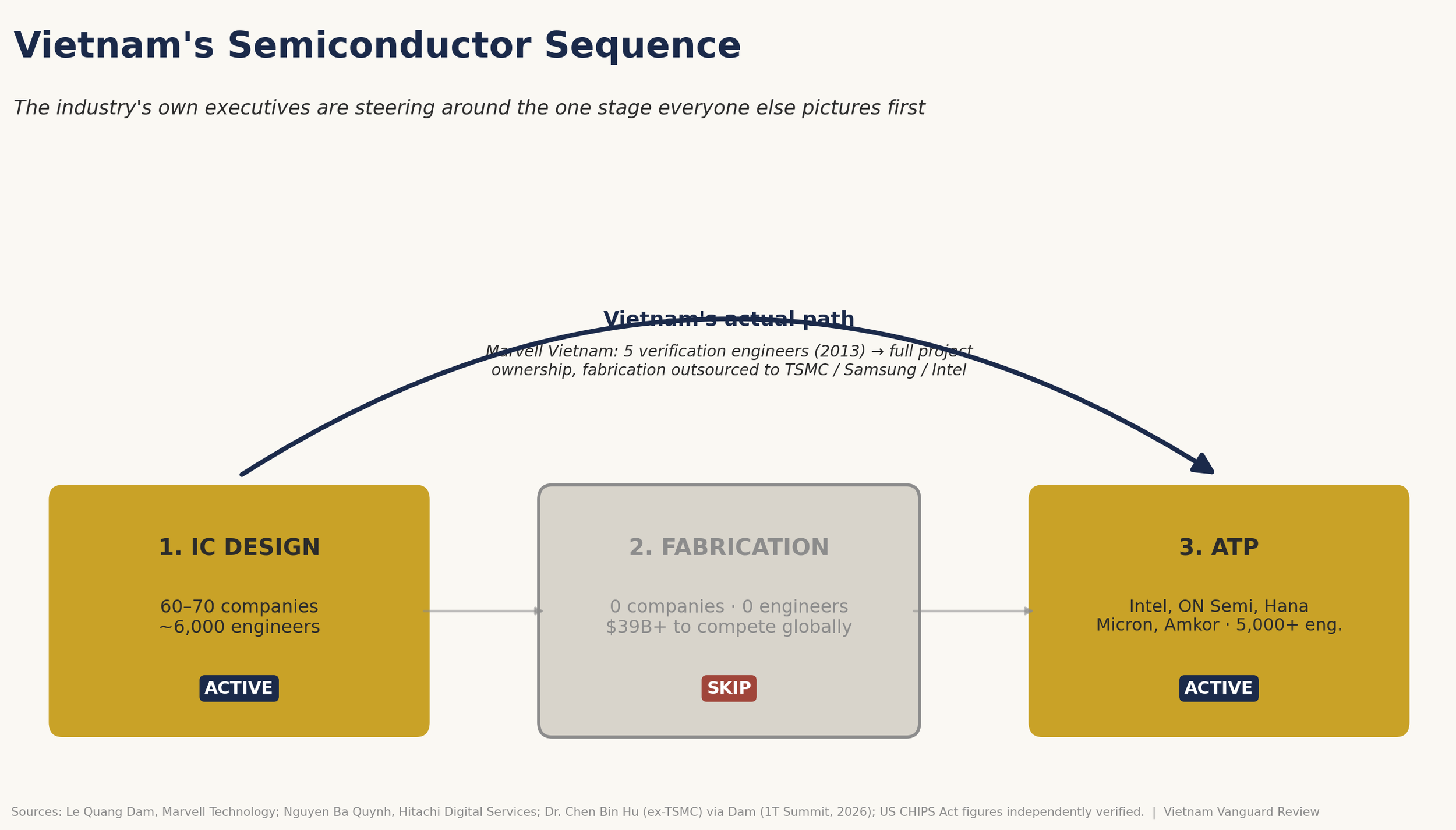
Dam laid out the industry's structure plainly: an integrated circuit moves through four stages — IC design (the idea), fabrication (etching it into silicon), assembly-testing-packaging or "ATP" (making it reliable and shippable), and materials supply (the chemicals and inputs the other three stages need). Vietnam today has real, growing presence in two of the four. IC design: roughly 60 to 70 companies as of 2026, up from a handful in 2000, employing around 6,000 engineers. ATP: anchored by Intel — still the largest employer in the segment — alongside ON Semiconductor, Hana Micron, and Amkor, with another 5,000-plus engineers. Fabrication: zero companies, zero engineers, by Dam's own account.
That's not an oversight. It's the deliberate result of a conversation the industry has already had with itself.
The Verdict From Someone Who Spent a Career at TSMC
Dam relayed it directly: "Last month, I was on a panel discussion with Dr. Chen Bin Hu. He is an ex-TSMC executive and an emeritus professor from UC Berkeley. When asked about Vietnam's priority list for the semiconductor industry, his conclusion was very clear. First priority should be IC design. Second priority should be ATP. For fabrication, he said there is very little chance for Vietnam to be successful or competitive." Dam's own assessment matched it: "That assessment is realistic, especially if the goal is commercial scale and profitability."
Nguyen Ba Quynh went further, framing the point as a deliberate departure from boosterism: "I will try to be a little bit more controversial this time, not trying to sell Vietnam... Are we going to participate in semiconductor manufacturing? I guess not. It is an asset-heavy industry requiring billions, even tens of billions of dollars of investment, and it needs massive scale."
The scale he's describing is real and checkable. The US CHIPS and Science Act directs $280 billion in spending overall, but the portion that's actually semiconductor manufacturing subsidy — grants for building and expanding fabs — is roughly $39 billion of that, on top of tax credits. The EU and China have committed comparable sums to their own domestic fabrication buildouts. And per Ba Quynh, only three countries on earth — the US, Japan, and the Netherlands — can even manufacture the machines sophisticated fabrication requires. Vietnam isn't choosing not to compete in fabrication because of modesty. It's a capital-intensity and industrial-base gap measured in tens of billions of dollars and generations of machine-tool expertise, and pretending otherwise would be the actual controversial position.
The Proof of Concept Already Exists
What makes this more than cautious advice is that the alternative — sequencing up from IC design rather than starting with fabrication — has already been run as a live experiment inside Vietnam, and it worked. Marvell opened its Vietnam office in 2013 with five engineers doing basic design verification. "We gradually expanded from design verification to physical design, to design-for-test, and then moved further into ASIC design and system architecture," Dam said. "Today, after more than ten years, our team can own an entire project — from idea, specification, system architecture, to implementation, generating GDS files that are then sent to third-party foundries such as TSMC, Samsung, or Intel for fabrication."
That's the whole strategy in one company's timeline: design domestically, fabricate elsewhere, and let the design capability compound for a decade until it owns the highest-value part of the chain without ever needing to build a fab.
What Actually Has to Be Built
Skipping fabrication doesn't mean the remaining strategy is easy — it just means the real constraints are different from the ones dominating the public conversation. Dam named three specifically. EDA tools — the software used to actually design chips — are controlled by three global providers (Cadence, Synopsys, Mentor Graphics), and licensing costs are high enough to lock out most startups and universities; he wants a government-backed shared-license program, not a subsidy for a fab Vietnam isn't going to build. IP and data protection frameworks are, in his words, "improving, but not yet clear or strong enough" — a real gap for both domestic and FDI companies, and one that matters more as Vietnamese teams take on more sensitive design work. And the industry needs more of its own returning diaspora — engineers with a decade or more at global firms who can shorten the learning curve the way Marvell's Vietnam team did.
Dam also flagged talent quality candidly rather than diplomatically: "Vietnamese engineers have good technical knowledge and expertise, but we still lag in soft skills... communication in English, teamwork, presentation skills, and how we work across teams." Ba Quynh's own recommendation pointed toward AI use-case development — not deep semiconductor R&D — as the more immediately unlockable investment category, on the logic that innovation right now is less about new hardware than about finding where AI removes cost from existing labor-intensive processes.
For the government's industrial-policy planners: the highest-leverage near-term moves are an EDA-tool-sharing program and a clearer IP/data-protection framework — both comparatively cheap, both named directly by the industry as binding constraints. A fabrication subsidy debate is a debate about a stage the country's own semiconductor executives have already ruled out.
For investors and companies evaluating Vietnam semiconductor exposure: price the IC design and ATP segments, not a hypothetical fab. Marvell's ten-year arc from five verification engineers to full project ownership is the realistic timeline and the realistic ceiling — a genuine value-capture story, just not the one that shows up in fab-groundbreaking press photos.
For universities and workforce planners: the gap holding back faster scaling isn't technical aptitude — Dam is explicit that it isn't — it's English communication, cross-team collaboration, and presentation skill. That's a curriculum and soft-skills problem, considerably cheaper to fix than a talent-pipeline problem, and worth treating as the priority it apparently already is inside the industry.
Insights from 1T SUMMIT — Jan 7th, 2026
— Vietnam Vanguard