
The Vinamilk Ceiling: Why Thai Capital Stopped at 24.99%
February 16th, 2026
—Vietnam Vanguard
For six weeks this year, Vietnam's largest dairy producer looked like it was changing hands. It wasn't. What happened instead is more interesting than the takeover story — and more useful for anyone trying to read how Thai capital actually operates inside Vietnamese consumer assets.
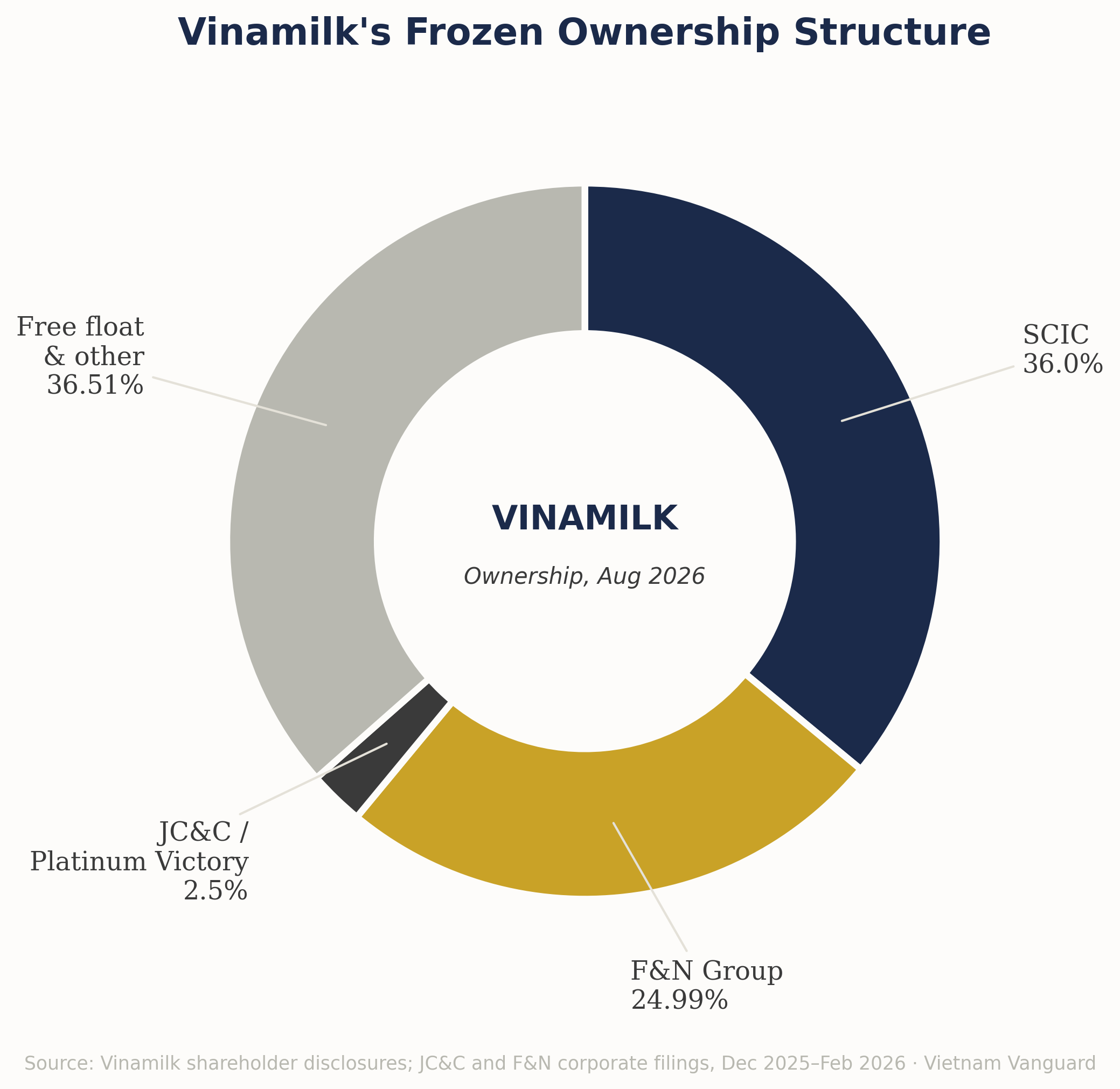
Jardine Cycle & Carriage registered in late January to sell its entire remaining 6.02% stake in Vinamilk — 125.76 million shares, the last of a position it had built since 2017. By the time the sale closed on 26 February, it had sold 3.5%, not 6.02%. It kept 2.5%. Meanwhile, Fraser & Neave — the Singapore-listed arm of Thai billionaire Charoen Sirivadhanabhakdi's TCC-ThaiBev group — completed its own purchase in December, taking its stake to 24.99%. Not 25%. Not 30%. F&N said explicitly, in its own investor update, that it has no immediate intention of going higher.
That number is not an accident. It is the whole story.
What Actually Happened
The sequence matters more than the headline. On 22 December 2025, F&N Dairy Investments completed a block-trade purchase of 96.09 million Vinamilk shares — 4.6% of the company — directly from Platinum Victory, JC&C's holding vehicle, for roughly $228 million. That single transaction lifted F&N's combined stake (through F&N Dairy Investments and F&NBev Manufacturing) from 20.39% to 24.99%, and dropped JC&C's position from 10.62% to 6.02%.
Five weeks later, JC&C registered to sell everything it had left. The market read this — reasonably — as a full exit after nearly a decade as a strategic shareholder. VNM shares fell more than 5% on the news. But the registration and the outcome diverged. When the sale actually executed on 26 February, JC&C sold 73.21 million shares — 3.5% of the company, for about $188 million, arranged by Jefferies through the HOSE trading system as a broad block trade, not a single named strategic buyer. JC&C kept 2.5%. Its board representative, Alain Cany, resigned — but the company did not disappear from the register, and there is no public confirmation that F&N absorbed the remaining tranche.
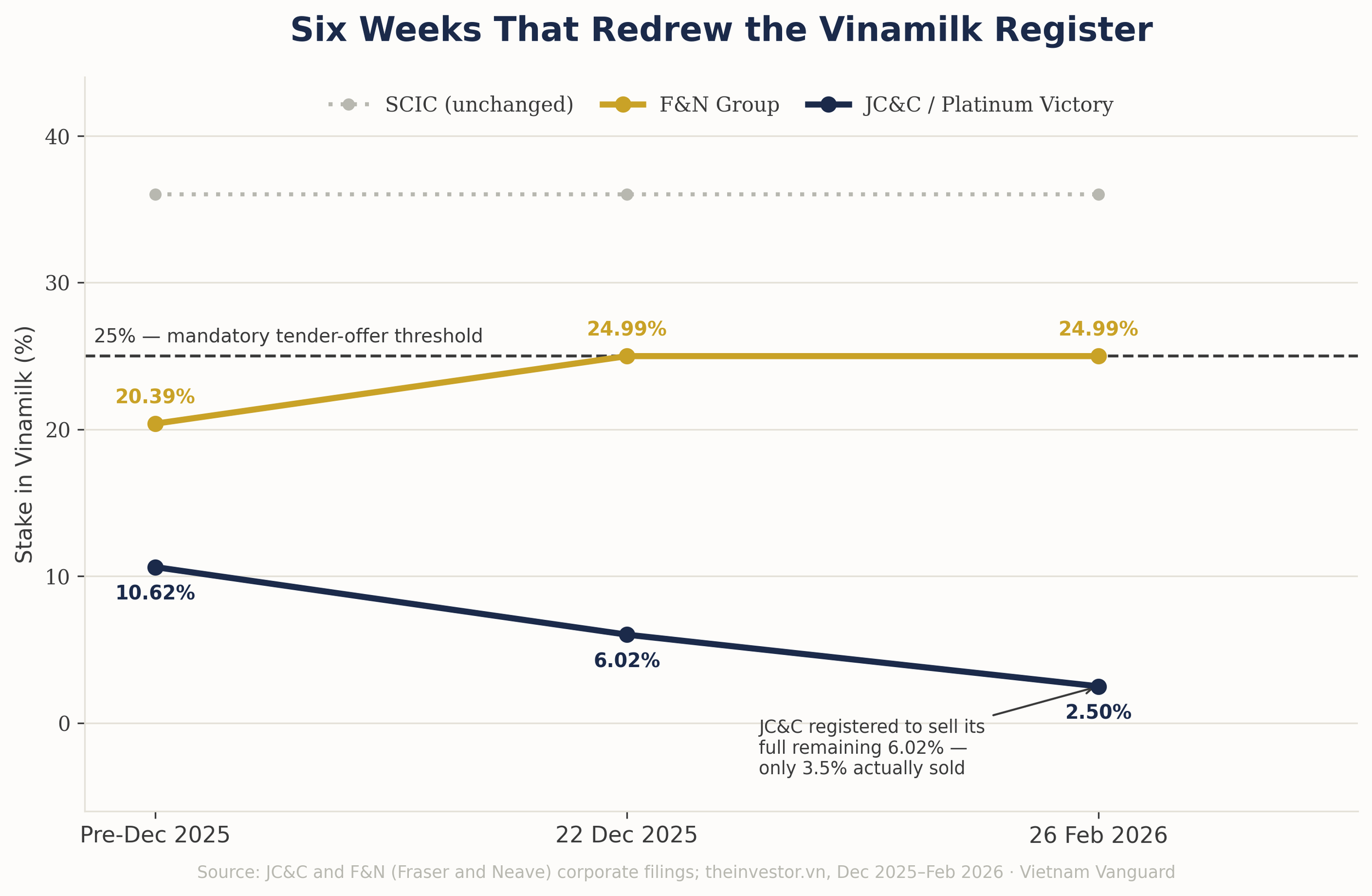
Running in parallel, and easy to miss: SCIC Investment Co., a subsidiary of the state shareholder, registered to sell its own token 1.45 million shares — 0.069% of the company, worth about $3.5 million — twice, in overlapping windows across December 2025 and February 2026. Both attempts lapsed without a completed trade, cited as "unfavorable market conditions." SCIC's own 36% position — nearly 752.5 million shares, still the largest single block in the company — has not moved. As of Vinamilk's most recent dividend distributions in mid-2026, SCIC remains the top shareholder by a wide margin over F&N.
Three shareholders, three outcomes: F&N stopped one basis point short of a threshold. JC&C registered to exit fully and executed a partial sale instead. SCIC didn't move at all — and couldn't even clear a rounding-error-sized sale when it tried. That is not a company in the process of changing hands. That is a structure in stasis.
The Line Nobody Priced In
Under Vietnam's Securities Law, an investor and its related parties that would cross 25% ownership of a public company — from below that level — must launch a mandatory public tender offer. Cross it again at 35%, 45%, 55%, 65%, or 75%, and the same obligation resets. It is a bright, well-understood line, and F&N's own disclosures show it calibrating directly against it: the December 2025 transaction was structured, in F&N's words, specifically to avoid taking the group "more than 24.99%" post-sale — a condition written into the sale agreement itself, not a coincidence of rounding.
This is not the first time a Thai buyer has engineered a Vietnamese acquisition around a regulatory line rather than through it. When Thai Beverage's Vietnam Beverage unit acquired 53.59% of Sabeco in 2017 for roughly $4.8–4.9 billion — one of the largest M&A transactions Vietnam has recorded — it did so through a domestically registered holding structure specifically because a direct ThaiBev acquisition would have been capped at 49% under foreign-ownership limits on conditional sectors like alcohol. Different law, same instinct: identify the regulatory ceiling, then build the deal structure to sit exactly beneath — or, in Sabeco's case, use a domestic vehicle to step past it — rather than force a confrontation with it.
At Vinamilk, F&N doesn't need the tender-offer threshold. It needs the economics, and it already has them. Since first investing in 2005, F&N is estimated to have collected roughly VND16.5 trillion (about $627 million) in cumulative dividends from Vinamilk — a return stream that scales with its stake regardless of whether it holds board control. Vinamilk has maintained a cash dividend payout in the 40–60% range for over a decade. Governance control matters far less than cash-flow exposure when the payout ratio is already this generous and SCIC's 36% makes outright control mathematically unreachable without a tender offer SCIC has given no indication it would entertain.

C.P. Vietnam Livestock Corporation, Bien Hoa 2 Industrial Park, Dong Nai Province
Two Decades, One Playbook
Vinamilk sits inside a much longer pattern of Thai capital deployment into Vietnam, and the pattern has been remarkably consistent in its target selection even as the deal sizes have grown.
The first wave, from the mid-1990s through the early 2000s, was greenfield: CP Group's 1993 entry into Dong Nai, SCG's building-materials joint ventures from 1994, Amata's industrial park in Bien Hoa from 1995. This was market familiarization, not acquisition.
After Vietnam's 2007 WTO accession, the strategy shifted to buying market position outright rather than building it: SCG's roughly $240 million acquisition of Prime Group in 2012, and Nawaplastic's build-up of stakes in Nhua Binh Minh and Nhua Tien Phong from the same year.
From 2016 onward, the deals scaled sharply and concentrated on category leaders in consumer-facing sectors: Central Group's approximately $1.05–1.14 billion purchase of Big C Vietnam in 2016; TCC Group's roughly $700–880 million acquisition of Metro Cash & Carry Vietnam around the same period; ThaiBev's $4.8–4.9 billion Sabeco deal in 2017 — a figure worth restating precisely, since it is routinely underreported in regional coverage as "around $1 billion"; and SCG's roughly $500 million consolidation of Nhua Binh Minh, Nhua Duy Tan, and Bao Bi Bien Hoa. Consumer finance followed the same logic — Krungsri's $156 million purchase of SHB Finance in 2021, and Siam Commercial Bank's approximately $900 million acquisition of Home Credit Vietnam in 2024.
Since 2019, energy and logistics infrastructure has become a third leg: B.Grimm Power and Gulf Energy have committed an estimated $4–5 billion combined to Vietnamese wind and solar, while WHA Group has been building out a 350-hectare industrial park in Nghe An since 2017 — infrastructure that quietly underwrites the retail and manufacturing plays sitting on top of it.
Across two decades, the exit rate on these positions has been unusually low. Thai capital in Vietnam has behaved like capital with a multi-decade time horizon, not capital hunting for a re-rating.
Thailand's Growth Problem Is Vietnam's Opportunity
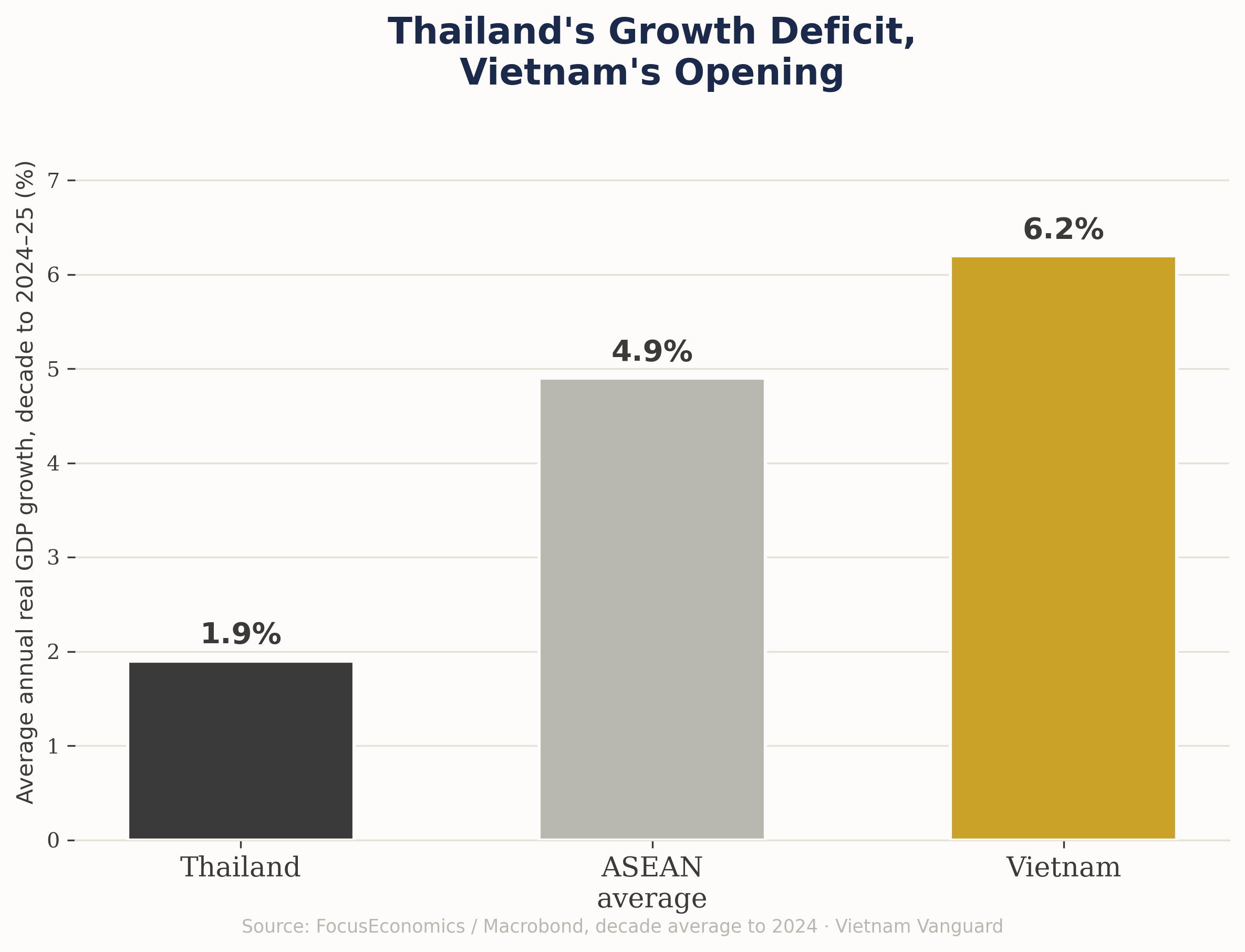
The push outward is not optional for Thai conglomerates — it is a response to a genuine domestic growth deficit. Thailand's economy grew at an average of roughly 1.9% annually over the decade to 2024, against a roughly 4.9% average across ASEAN over the same period, according to FocusEconomics data drawing on Macrobond figures. Forecasts for 2026 put Thailand at the bottom of the regional growth table — behind every major ASEAN economy, including, on some projections, Myanmar. Against that backdrop, Vietnam's combination of a young workforce, sustained high growth, and geographic and cultural proximity has made it the default outlet for Thai firms seeking growth their home market can no longer supply. Vietnamese executives have heard versions of this logic directly from Thai counterparts for years — the market is not speculating about Thai motives; the companies say it themselves in their own investor materials.
The Moat Vinamilk's Own CEO Calls a Weakness
The bull case for why any acquirer would want Vinamilk specifically is well rehearsed: more than 220 exclusive distributors, close to 250,000 traditional retail points of sale, and a direct-control distribution model that lets the company manage shelf placement and inventory down to individual grocery stores — a structure that gives Vinamilk roughly double the effective retail coverage that Kantar considers "well-covered" for a Southeast Asian dairy player. In a market where traditional trade still accounts for the large majority of FMCG value, that reach is real.
It is also, by Vinamilk's own admission, overdue for an overhaul. CEO Mai Kieu Lien told shareholders in 2025 that the domestic distribution network — those same 250,000 traditional retail points — had become the company's "biggest weakness," and initiated a restructuring of the distributor and sales-team layer that began delivering double-digit revenue growth by April 2025. The moat is real. It is also aging, and the company knows it. Any investor pricing Vinamilk purely on distribution scale, without pricing in the execution risk of a mid-overhaul sales organization, is pricing half the picture.
What This Means
For investors: stop pricing a Thai-control scenario into Vinamilk. The structure that exists today — SCIC at 36%, F&N at 24.99%, JC&C at a residual 2.5% — is not a transition state. It is close to the most stable configuration Vietnamese securities law and each party's own stated intentions can currently produce, absent a change in SCIC's position. The near-term investment case is a high-payout consumer staple undergoing a distribution overhaul, not a takeover target.
For boards and executives elsewhere watching Thai capital move through Vietnamese sectors: expect the same pattern you've now seen twice — at Sabeco with the 49% foreign-ownership cap, and at Vinamilk with the 25% tender-offer trigger. Thai acquirers are not testing regulatory thresholds to see how much they can extract past them. They are building positions calibrated precisely against them, because the cash-flow economics work without the governance fight attached. Recognize the pattern in your own cap table before a counterparty uses it against you.
On the state shareholder's side, the facts are simple and worth stating without embellishment: SCIC's 36% stake has not moved, and a symbolic 0.069% sale attempt failed to clear on two separate occasions in the same window that a strategic foreign shareholder was actively restructuring its position. Whatever the eventual path for that stake, it has not started.
Vinamilk was never going to change hands over a six-week trading window. What changed was the precision with which the ceiling got drawn — and the fact that, for now, everyone appears to be standing exactly where the line allows them to stand.
—Vietnam Vanguard
February 16th , 2026