
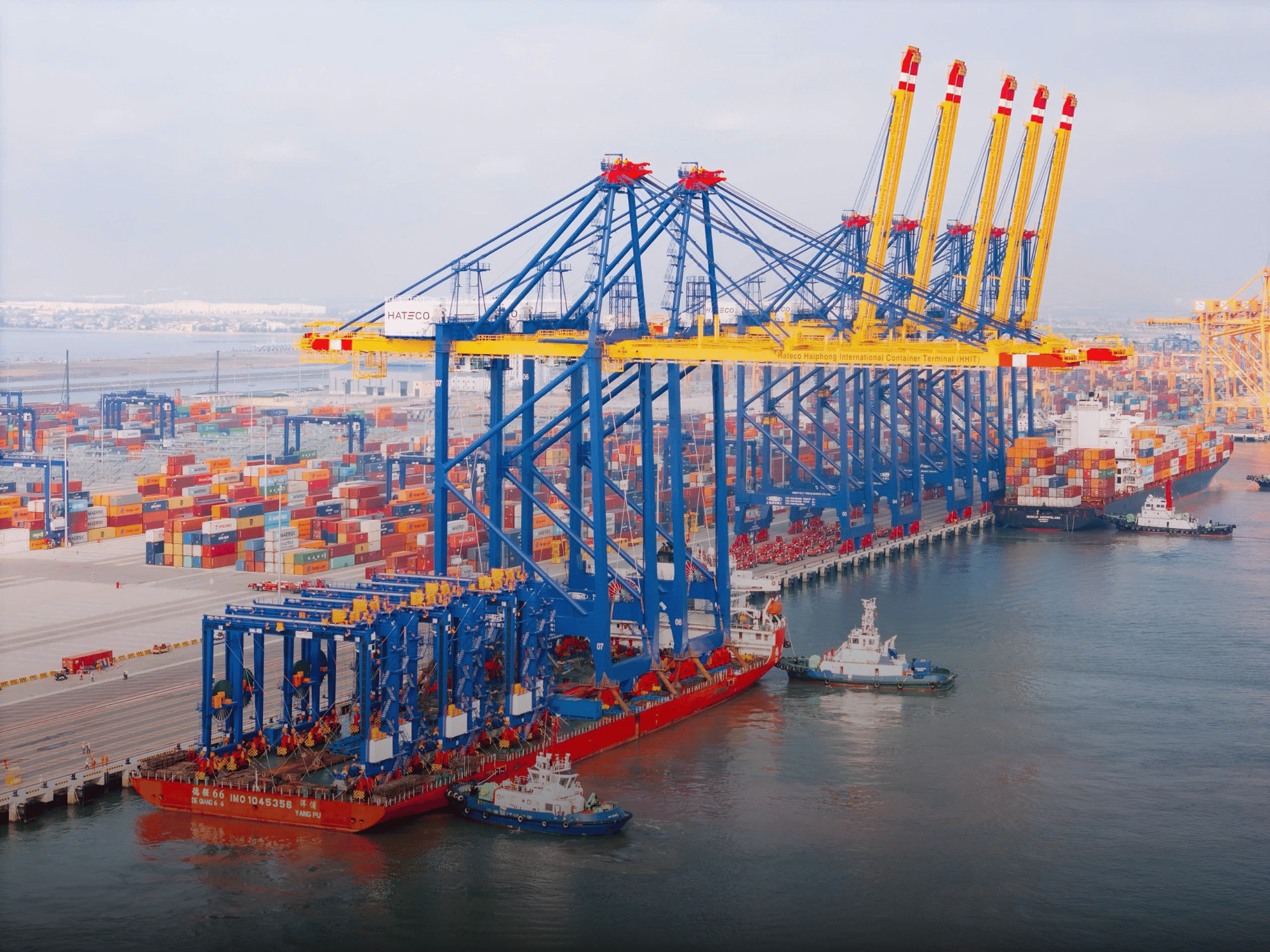
Vietnam's economy grew 9.95% in the third quarter of 2026, and 9.01% across the first nine months. It is the fastest expansion in Southeast Asia and the strongest nine-month figure since 2011.
In the same nine months, a $16.87B trade surplus became a $19.42B deficit.
The two facts are not in tension. Of the $453.72B Vietnam imported, 94.1% was machinery, components and materials for production. The country bought more because it made more, and it had to buy because it cannot make the inputs itself.
That is the structural question behind the $1T ambition, and it is not a question about speed. What remains in doubt is how much of the value created inside Vietnam's borders stays there.
The deficit is not a trade story
The aggregate figure conceals the thing worth looking at. In the first ten months of 2026, Vietnamese domestic enterprises ran a trade deficit of $36.9B, a 92.2% increase on the year before. Over the same period the foreign-invested sector ran a surplus of $24.83B — down 35.8%.
One economy is importing. The other is exporting, and exporting less profitably than it was.
The foreign-invested sector generated roughly $405.31bn of exports in the first ten months, about 81.2% of the national total. Manufactured goods made up 90.7% of what Vietnam sold abroad. Strip out the foreign-owned factories and what remains is a trade position that looks nothing like the headline.
None of this is news to anyone who has read the development literature. The World Bank records the share of Vietnamese firms participating in global value chains falling from 35% in 2009 to 18% in 2023. The OECD estimates foreign value added at 48% of export value in 2020. What is new is that the gap is widening during the best growth year Vietnam has had in fifteen years.
The Ministry of Industry and Trade's own 2025 figures put the point beyond argument: local firms met about 10% of demand for components and spare parts. Local content ran at 5–10% in electronics and 7–10% in cars. The official target is 40–45% in key industries by 2030, and a more modest 25–30% for electronics.
Six years to multiply local content fourfold. The question is what, specifically, is supposed to change.
Why thirty years of FDI did not build suppliers
The standard explanation is that Vietnamese firms lack capability. It is true and it is insufficient, because capability is an outcome, not a cause. The more useful question is what the system has been paying firms to do.
Three answers, none of them flattering.
Incentives are granted per project, not per linkage. Vietnam has competed for foreign investment on tax holidays, land and speed of approval. It has rarely competed on the condition that an investor source locally. An incentive structure that rewards arrival rather than integration produces exactly what Vietnam has: world-class assembly, 82.9% of realized FDI in processing and manufacturing, and a supplier base that meets a tenth of component demand.
Tier-one suppliers follow their anchors. When a Korean or Japanese or Taiwanese manufacturer moves a plant to Vietnam, its established suppliers move with it. They arrive with qualified processes, existing contracts and no commercial reason to replace a known supplier with an unproven local one. The supply chain relocates intact. Vietnam hosts it; it does not enter it.
Domestic capital has had better things to do. For two decades the risk-adjusted return on property and financial assets in Vietnam has comfortably exceeded the return on precision manufacturing, which demands patient capital, technical depth and a decade before it pays. Capital allocated rationally. The result is a private sector that is large and a supplier sector that is thin.
None of this is a failure of effort. It is a system producing what it was built to produce — which is also why exhortation will not change it, and why the 40–45% local content target will not be met by asking.
The arithmetic of 10%
Vietnam has set out to grow at a minimum of 10% a year from 2026 to 2030, to enter the world's 30 largest economies by 2030, and to reach high-income status by 2045.
The Ministry of Industry and Trade forecasts a power capacity shortfall of roughly 4,256 MW in 2027, rising to nearly 14,000 MW by 2030, with a projected electricity deficit of up to 61bn kWh. The north faces the greatest pressure.
These are two official documents describing the same five years. They are not compatible.
No economy has sustained 10% growth while short a seventh of the power its industry needs. The growth target assumes industrial expansion; the power forecast assumes that expansion cannot be fully served. One of the two will give way, and it will be growth, because electricity is the harder constraint to argue with.
This is not an argument that the ambition is wrong. It is an argument that the ambition has a bill attached, and the bill is denominated in megawatts, transmission and the capital to build both.
The race next door
Vietnam is winning the contest for volume. Registered FDI reached $54.85B in the first ten months of 2026, up 74% year on year and the highest since 2009. Disbursed capital reached $24.08B, up 13.1%, the strongest ten-month figure in five years. No regional peer is growing its inbound investment at that rate.
It is losing, or at least not yet contesting, the race for composition.
Malaysia approved about $54.2B of investment in the first half of 2026, of which roughly $23.8B — nearly 44% — went to data centers and cloud computing. Its advantage is not the pipeline but the foundation underneath it: Penang has been a semiconductor hub since the early 1970s, and in 2024 accounted for around 60% of Malaysia's electrical and electronics exports. That ecosystem took fifty years. It cannot be out-incentivized.
Thailand's applications for investment incentives reached about $50.3B in the first nine months of 2026, up 28%, with foreign applications up 62% to $45.7B, concentrated in AI, data centers, semiconductors and electronics. Indonesia is running a different play, using resource endowment and down-streaming policy: around $26.7B into downstream industries over the same period.
Singapore is not competing for the same capital. It is allocating it. Singapore led the 80 economies investing in Vietnam in the first ten months of 2026, accounting for nearly a third of newly registered project capital — which makes it less a rival than the channel through which much of the region's capital reaches Vietnam at all. That is a different kind of advantage, and a harder one to replicate.
Vietnam's 82.9% concentration of realized FDI in processing and manufacturing is a genuine strength and a genuine exposure. It is the reason the growth numbers are what they are. It is also the reason the composition problem does not fix itself.
Capital that waits
Industrial upgrading needs patient money. Not money for factories and equipment, which Vietnam's banks will lend against, but money for technology development, product cycles, workforce training and supplier qualification — none of which produce collateral.
Outstanding bank credit stood at roughly 145% of GDP in 2025. The corporate bond market and the institutional investor base remain small. A financial system weighted that heavily toward secured lending finances expansion well and transformation poorly.
Two changes are under way. The International Financial Centre, with operations in Ho Chi Minh City and Da Nang, opened membership registration in August 2026, and in September Deputy Prime Minister Nguyen Van Thang pressed for financial products and transactions to go live. And FTSE Russell upgraded Vietnam to Secondary Emerging Market status, effective 21 September 2026, with 27 Vietnamese stocks scheduled for inclusion in the FTSE Global All Cap index on a phased basis through September 2027.
An index upgrade puts a market on the screen. It does not supply the companies. Resolution 68 targets two million operating businesses by 2030, including at least 20 participating in global value chains, with the private sector at 55–58% of GDP. Vingroup, 26th on the 2026 Fortune Southeast Asia 500 with revenue of $12.8B, up 69%, proves Vietnamese firms can reach scale. One group is not a corporate sector.
What it means
For Vietnamese corporates. The supplier gap is the largest uncontested commercial opportunity in the country. Component and materials demand runs at $426.92B a year and is being met overseas at a rate of about nine parts in ten. The constraint is not demand; it is qualification — process certification, capital with a ten-year horizon, and technical partnerships that most domestic groups have not sought. Firms that solve qualification before 2030 will be buying from a position of strength. Firms that wait will be bought.
For foreign investors. Vietnam's cost and speed advantages are intact and its growth rate is real. The risk has moved. It is no longer political or macroeconomic; it is operational — power availability in the north from 2027, and a supplier base that will not reduce import dependence on the timeline most boards assume. Price the grid, not the tax holiday.
For policymakers. The local content targets and the growth targets are set. The instruments that would deliver them — linkage conditions attached to incentives, supplier development finance, transmission built ahead of demand — are not set at the same scale. The gap between the two is the policy agenda for the next thirty-six months.
The $1T question
Vietnam will almost certainly reach $1T in nominal output. On current growth rates the arithmetic does that on its own, and sooner than most forecasts assumed two years ago.
What the number will not say is how much of that trillion Vietnam owns.
An economy can be large and still be rented. The work of the next five years is not to grow faster — Vietnam has solved that — but to make sure that when the trillion arrives, it belongs to someone here.
1T Summit 2026 — The New Race for Global Capital in Southeast Asia takes place in Ho Chi Minh City on 3 December.
The argument above is the one the Summit exists to test, and we have invited people who disagree with it. The agenda runs across international capital, the International Financial Centre, AI and energy infrastructure, supply chain upgrading, agri-food, and what it takes to build Vietnamese firms large enough to compete beyond the home market. Where the Fortune Southeast Asia 500 Summit on 3 November took a regional view, 1T Summit puts Vietnam's own competitiveness in the chair.
Disclosure: 1T Summit is organized by Vietnam Vanguard, which publishes this article, in partnership with the Ho Chi Minh City Investment and Trade Promotion Centre and the Singapore Economic Development Board. Cuong Dang is founder and chair of Vietnam Vanguard and Fortune Asia's Country Head in Vietnam. The Fortune Southeast Asia 500 Summit referenced above was organized by Fortune.
